メインコンテンツへスキップ
Context Grammar文脈を読むAIをデザインする

Context Grammar — Stage 6

AX Patterns

▶Listen to this page

A rule may find that your weekly groceries are due. The Negotiation Gate decides whether the order can go ahead. AX Patterns shape what happens next: a quiet receipt, a request to approve a costly substitute, or an explanation of why the order stopped.

気の利いた手伝いを、画面と動きにする。

音声:英語

文字起こしを読む

AX Patterns · Helpful behavior you can see and use

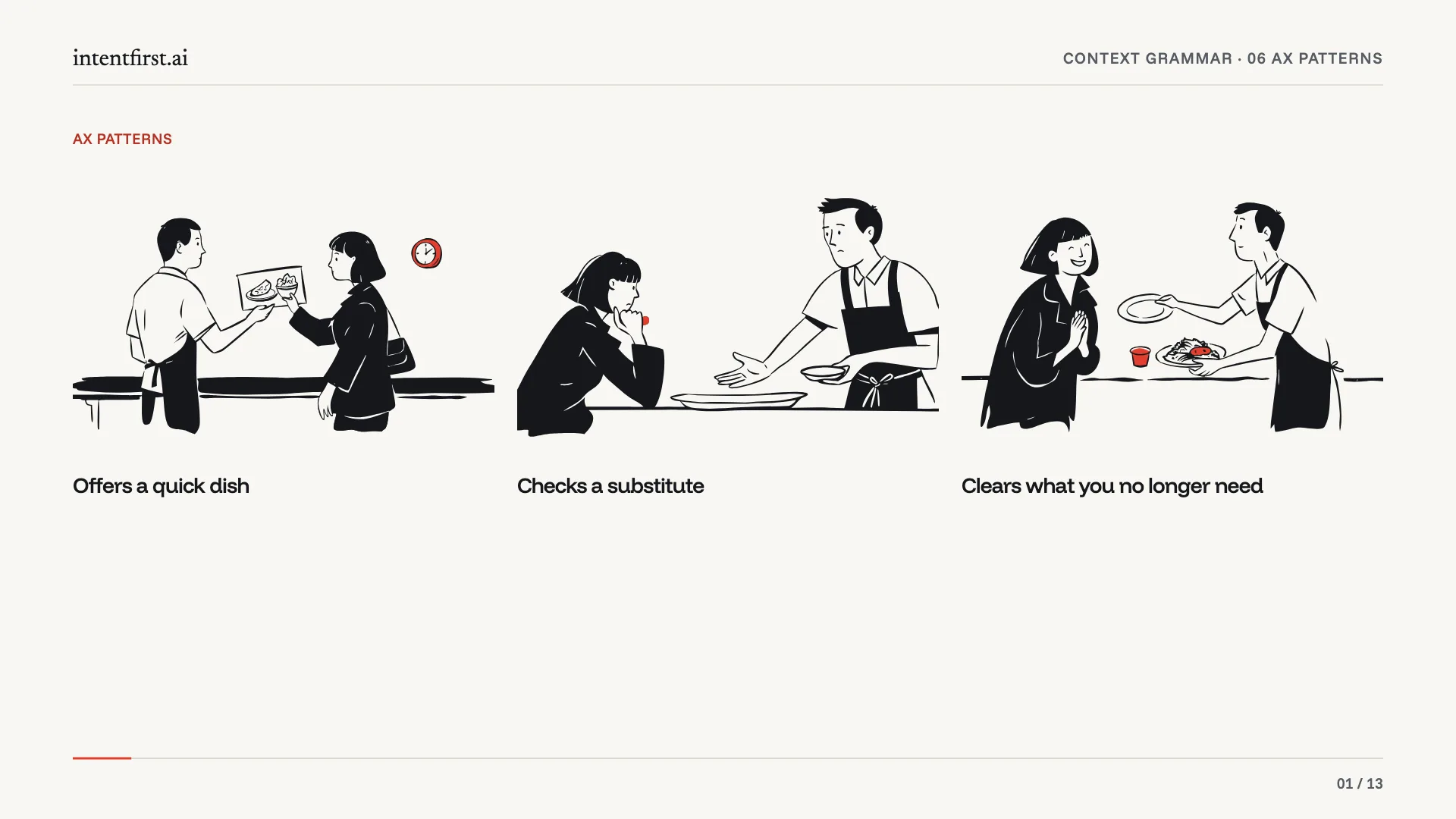
急ぐ客には、すぐ出せる一品をすすめる。いつもの料理がなければ、代わりを相談する。食事が終われば、メニューは下げて会話の邪魔をしない。こうした動きがあるから、気遣いが相手に伝わります。AIでも、「状況を理解しました」だけでは足りません。何を見せ、どこで聞き、どう引き継ぐか。その具体的な振る舞いをまとめたものがAX Patternsです。

Delegate / Ask for help / Adapt / Explain

家族の買い物を手伝ってもらう一日で見てみましょう。安心して任せるためのDelegation。分からないときに本人へ相談を戻すEscalation。状況に合わせて変えるAdaptation。そして、理由や資料を確かめられるEnterprise。ページには、この四つに分けた二十三の型があります。名前を覚える前に、それぞれが何をしてくれるかを見ていきます。

D1 Approval Gate / D2 Progressive Trust / D3 Proactive Nudge

子どもの靴を買う前に、サイズと値段を見て直せる。これがApproval Gateです。何度か頼み、訂正もきちんと反映されたら、その品を少ない手間で任せられるように相談する。これがProgressive Trust。休日の余裕があるときに「靴を比べますか」と控えめに誘うのがProactive Nudgeです。頼みやすさは、提案の中身だけでなく、出すタイミングでも変わります。

D4 Omakase / D5 Substitution Modes / D6 Dynamic Friction

日用品は、決めた範囲で補充しておいてもらう。これがOmakase Modeです。売り切れのときの希望も選べます。同じものだけのExact、条件内で代えてよいFlexible、新しい候補も見たいExploring、決めた範囲で選んでほしいSurprise。これらがSubstitution Modesです。代わりが高額なら、その品だけ確認するDynamic Frictionが働きます。

E1 Confidence Signal / E2 Limitation Disclosure

「このサイズが合いそうですが、まだ足を測っていません」。確かでない部分が見えるのがConfidence Signalです。「この店の在庫は確認できません。店へ問い合わせますか」と、できないことと次の方法を示すのがLimitation Disclosure。どちらも、親が測る、問い合わせる、別の店を見るといった次の選択につながります。

E3 Rollback / E4 Ambiguity Escalation / E5 Recovery

取り消せる注文を止めるのがRollback。「安さと早さ、どちらを優先しますか」と本人へ相談するのがAmbiguity Escalation。そして、違う品を注文してしまったら、対応を調べ、次からはその品を確認してもらう。これがTrust Breach Recoveryです。止まった理由だけでなく、何を選べて、その後どう変わるかまで見せます。

A1 Form Factor Transform / A2 Cognitive Scaling / A3 Social-Aware Filtering

子どもが選びやすいよう、靴の写真をテレビへ並べ、親の携帯に値段と購入操作を残す。端末ごとに役割を変えるのがForm Factor Transformです。忙しい親にはまず一案、あとで比較を広げるのがCognitive Scaling。家族の共有画面に私的な通知を出さないのがSocial-Aware Filtering。三つを組み合わせると、一緒に選びやすい買い物になります。

A4 Disclosure Cascade / A5 Disposable Surface / A6 Care Architecture

仕事の詳しい資料を、別の相手には共有してよい要約にするのがDisclosure Cascade。靴を選ぶ間だけ比較画面を出し、終われば閉じるのがDisposable Surfaceです。共有してよい好みから「お母さんもこの映画が好きだそうです」と会話のきっかけをつくるのがCare Architecture。画面を増やすことより、人の用事や関係を手伝うことを考えます。

A7 Live Recomposition / A8 Temporal Handoff

旅行の日に雨が強くなった。楽しみにしていた予定と休憩時間を守りながら、屋内の行き先へ組み直すのがLive Recompositionです。帰ってから「午後の休憩は次も入れたい」と確認したことを、家族の記憶へ戻すのがTemporal Handoff。その日の変更で終わらず、次の旅の相談にも経験が生きます。

X1 Reasoning Trace / X2 Inline Edit

「どうしてこの宿?」と聞いたら、駅から近く、予算内で、子どもの休憩も取れるから、と使った条件が見える。これがReasoning Traceです。「予算を少し上げても、もっと駅に近く」と、その提案の中で直せるのがInline Edit。説明を聞いたあと、別の画面で最初からやり直さず、そのまま相談を続けられます。

X3 Autonomy Dial UI / X4 Source Attribution

日用品は任せるけれど、宿は予約前に聞いてほしい。その設定を実際に操作できる形がAutonomy Dial UIです。宿の空きがいつ、どこの情報で確認されたかを見せるのがSource Attribution。昨日のメモか、今のお店の返答かを区別できれば、判断しやすい。Enterpriseという分類ですが、こうした確かめやすさは家庭でも役に立ちます。

Patterns work together in one experience

朝の日用品は静かに補充される。一品だけ欠品したので、代わり方の設定を確かめる。大きな値上がりになるため、その品だけ待たせる。親が一息ついたら、「今回は外しますか、別の品にしますか」と短く尋ねる。いくつかの型を合わせることで、使う人には、一人の気の利く相手に手伝ってもらうような流れになります。

Design the behavior, from beginning to end

知らせる、すすめる、計画する、準備する、実行する、様子を見る、変化に合わせて直す。資料ではInform、Recommend、Plan、Prepare、Act、Monitor、Adaptという動詞でも整理しています。たとえば旅行の計画でも、必ず全部を順番に通るわけではありません。いつ始まり、何をして、どう終わるのか。その約束までそろえると、端末が変わっても、頼み方が分かる体験になります。
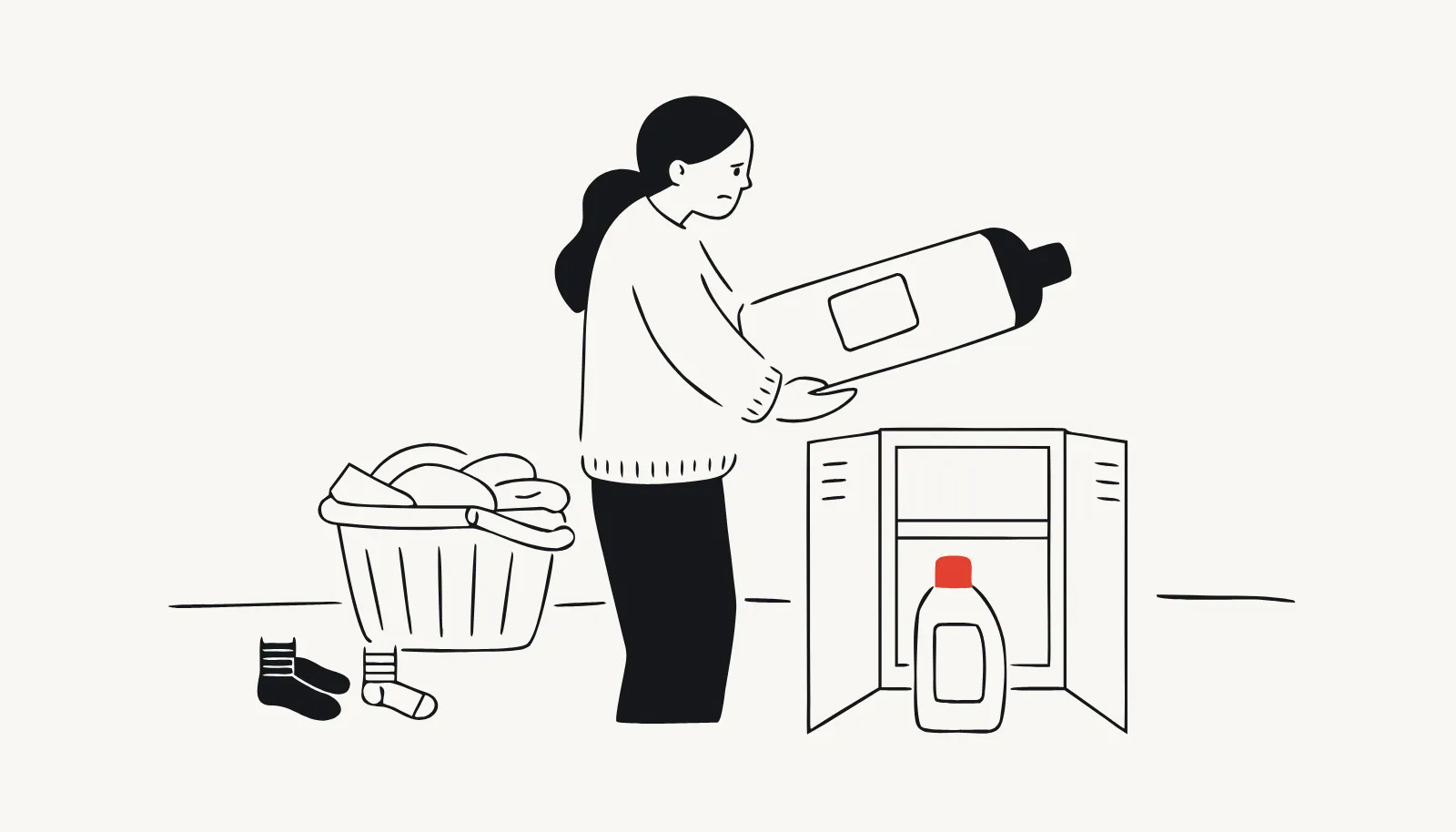
A parent holds a large detergent bottle that will not fit in the small cupboard.
大きく高い代替品は、届く前に本人へ戻ります。見えて、使える気配り。
◆ Stage 6 · AX Patterns

The Gate has decided. How should it reach you?

Explore a branch or catalog row to see a reusable behavior, the condition that calls for it, and its action verb.

Categories
DDELEGATIOND1D2D3D4D5D6EESCALATIONE1E2E3E4E5AADAPTATIONA1A2A3A4A5A6A7A8XENTERPRISEX1X2X3X4GATE DECIDES

Current catalog: 23 patterns · 4 branches — select a node to read its behavior in the catalog →

◆Catalog · 23 of 23

Full delegation to AI when trust, disclosure, and confidence are high.

Context: A routine, low-risk task passes the Gate's limit. The agent acts quietly and keeps a record of the completed action for review.

triggerAutonomy = Auto + Disclosure = Full + Brain trust high.
verbAct
D × 6 · E × 5 · A × 8 · X × 4 — patterns compose: Silent Resolution = D4 + D6 + E5 + A2.
01A pattern starts from an explicit condition, including Signals, Dials, or Brain state.
02Its behavior can travel across domains and devices.
03Several patterns can shape one experience.

Read this first

The Gate sets the boundary. Patterns shape the encounter.

The Rule Engine proposes a response. The Negotiation Gate checks whether the agent may act, must ask, or must stop. This library names the repeatable ways to carry out that decision and show it to a person. The current catalog holds 23 patterns in four families; the count is reference and will change as the catalog grows.

D1-D6

Delegation

When AI may take on work, and which decisions stay with the person.

E1-E5

Escalation

How AI returns a decision when it is uncertain, unable to act, or corrected.

A1-A8

Adaptation

How the same response changes for a person's situation, device, or audience.

X1-X4

Enterprise

How teams inspect sources, edit proposals, and control consequential actions.

///

Two core behaviors

Show where things stand. Speak up at the right points.

Every pattern in the catalog serves two behaviors that do not change from version to version: the person can always see where things stand, and the AI knows in advance when it will speak up.

01

Show where things stand

What is done, what is waiting, and what comes next, in a form the person can use right now.

Everyday: one card on a rushed parent's phone — “Staples ordered. One substitute is waiting for you.”

Building with AI: “Welcome back, here's where we are”, or a “now” page readable on a phone.

02

Check-in points

When it speaks up: the Gate needs a decision, the ask is done, or something changed that the person would want to know. Otherwise it stays quiet.

Everyday: the usual item is ordered quietly; a pricier substitute is asked about.

Building with AI: the boundary card — “The ask is done. Continuing would be a new decision.”

When the person asks why, Decision Rationale (X1) answers: what information was used, which rule fired, what was assumed, and what was done. It is a record of the decision, not the model’s inner thinking.

Definition

A pattern is a repeatable way to respond.

Each pattern names a condition and a repeatable response.

Consider a grocery item that is out of stock. A rule can identify an acceptable substitute; the Gate can require confirmation because it costs more. D1 Approval Gate then presents the proposed swap with approve, edit, and reject choices. The pattern describes that handoff, not the particular grocery screen.

The same approval behavior can appear on a phone for groceries or on a desktop for a work purchase. Its wording and layout change with the surface; its decision contract stays recognizable.

from_decision_to_experience
Rule → propose the response
Gate → set the action boundary
Pattern → carry it out and make it legible
// one decision, many possible surfaces
Test 1

Explicit condition?

Name the Signal, Dial, Brain state, or event that calls for it. “When it feels right” cannot be tested.

Test 2

Reusable across contexts?

The same decision logic should work in more than one domain, such as shopping and work approvals.

Test 3

Device-independent?

The interaction logic should survive a move from phone to desktop, even when the controls change.

Pattern vs. not a pattern

A useful pattern says when it applies, what happens, and what counts as success.

Pattern

D4 Omakase Mode

The agent can place a routine grocery order quietly when Autonomy is Auto, Disclosure is Full, and domain trust in Brain L2 is high. A record of the action remains available. Higher-risk items still face the Gate's limit.

Not a pattern

"Smart suggestions"

"Show a suggestion when AI feels confident" gives no threshold, timing rule, or defined choice for the person. A team cannot tell when it should appear or whether it behaved correctly.

Categories

Four categories. The current catalog has 23 patterns.

Delegation moves bounded work to AI. Escalation returns a decision to a person. Adaptation changes how the response appears. Enterprise adds controls for shared work and decisions that need a record.

In one grocery order, the agent can reorder familiar staples, ask about an expensive substitute, keep private prices off a shared display, and record who approved the change. Those are different behaviors serving one task.

[ IF-08-3directions — Delegation, Escalation, Adaptation flows ]
Three core directions plus enterprise constraints
D · 6 patterns

Delegation

Handing authority to AI. Trust is the prerequisite, so these patterns measure trust and act within risk limits.

E · 5 patterns

Escalation

Returning control to humans. Uncertainty outranks delegation, regardless of the Autonomy Dial.

A · 8 patterns

Adaptation

Changing the interface with context. Content may stay the same while form, density, and visibility shift.

X · 4 patterns

Enterprise

Patterns for multi-person, compliance-heavy, or audit-required contexts. They use the same directions with stronger trust requirements.

Explore the catalog

Start with a behavior, then inspect its condition.

The explorer above lets you browse the current catalog of 23 named behaviors by family. Select a pattern to see its typical trigger and primary action verb. The entries describe a proposed design vocabulary; selecting one does not run an agent or evaluate a live situation.

reading_a_pattern
Condition → when it applies
Behavior → what the person experiences
Verb → the agent's primary kind of action

Execution contract

Seven verbs name what the agent does.

A pattern's verb gives design and engineering a quick description of its role: inform, recommend, plan, prepare, act, monitor, or adapt. These are tags for kinds of work, not seven steps every request must pass through.

VerbMeaning in executionTypical AX use
InformMake state, confidence, or provenance visible.Confidence Signal, Source Attribution, Limitation Disclosure.
RecommendPropose a direction while preserving user decision authority.Approval Gate, Proactive Nudge, Ambiguity Escalation.
PlanDraft a multi-step approach before committing to irreversible work.Substitution strategies and scenario shaping before action.
PrepareSet up context, options, and draft artifacts for a later decision.Inline Edit and Disposable Surface setup flows.
ActExecute directly within trust and risk constraints.Omakase Mode and low-risk auto-execution moments.
MonitorObserve outcomes, trust drift, and policy boundaries over time.Progressive Trust, Temporal Handoff, Autonomy Dial governance.
AdaptRecompose outputs when context, feasibility, or social state changes.Form Factor Transform, Rollback, Live Recomposition.

The Gate still sets the limit

If the Gate allows a routine action, an Act pattern may carry it out. If the Gate requires approval, the agent can still Prepare a draft and Recommend it, but cannot execute before the person decides. If the Gate blocks the action, an Inform pattern can explain why. The verb describes the response; it never grants extra authority.

Pattern catalog

The current catalog (23 patterns).

IDNameCore behaviorTypical triggerLifecycle verb
D1Approval GateUser approves, edits, or rejects an AI proposal before anything happens.Autonomy = Confirm + Priority Weight = high.Recommend
D2Progressive TrustAI earns permission to act with less friction after repeated success.Brain L2 success count crosses threshold.Monitor
D3Proactive NudgeAI surfaces a useful, non-urgent suggestion when attention is available.Cognitive Load = low + Feasibility = ok.Recommend
D4Omakase ModeFull delegation to AI when trust, disclosure, and confidence are high.Autonomy = Auto + Disclosure = Full + Brain trust high.Act
D5Substitution ModesExact, Flexible, Exploring, and Surprise substitution levels per item.Item unavailable + Brain has substitution preference.Recommend
D6Dynamic FrictionHigh-cost or high-risk actions keep confirmation even when trust is mature.Autonomy = Notify or Auto + action cost or risk exceeds limit.Recommend
E1Confidence SignalAI makes uncertainty visible in clear levels.AI confidence <= 80% + social consequence.Inform
E2Limitation DisclosureAI names what it cannot do and redirects to a better resource.Request outside capability + Priority Weight = high.Inform
E3RollbackAI reverses a completed action and offers alternatives when conditions change.Executed action + external Feasibility changed.Adapt
E4Ambiguity EscalationAI flags gray-zone decisions and gives the final call back to the human.AI confidence in a middle band.Recommend
E5Trust Breach RecoveryAfter an AI mistake, Autonomy is lowered and trust is rebuilt safely.User rejects, undoes, or overrides an AI decision.Monitor
A1Form Factor TransformThe same content restructures itself when the active device changes.Form Factor signal changes.Adapt
A2Cognitive ScalingDensity and choice count shrink when load is high, then expand later.Cognitive Load = high or overloaded.Adapt
A3Social-Aware FilteringVisibility changes based on who can see the content.Social Exposure >= medium + sensitive data present.Adapt
A4Disclosure CascadeInformation moves through Full, Summary, Existence, and Hidden levels.Disclosure Dial or social context changes.Inform
A5Disposable SurfaceA UI appears for one time-bound purpose and dissolves when complete.Intent is a time-bound goal + Disposable Brain exists.Prepare
A6Care ArchitectureAI uses relational context to surface care opportunities daily life hides.Brain L2 relational data + appropriate emotional timing.Recommend
A7Live RecompositionAn existing plan is rebuilt when weather, cancellations, or inventory change.External Feasibility changed + existing plan present.Adapt
A8Temporal HandoffUseful learnings return to persistent Brain when a Disposable Brain ends.Disposable Brain lifecycle ends + integration window opens.Monitor
X1Decision RationaleShows what information was used, which rule fired, what was assumed, and what was done. Available on demand; expanded for high-risk decisions. It is not the model's inner thinking.Priority Weight = high, audit rule, or user asks why.Inform
X2Inline EditAn AI proposal can be edited in place and re-run immediately.User selects edit at an Approval Gate.Prepare
X3Autonomy Dial UIUser-facing control over Suggest, Confirm, Notify, and Auto.User configures control level for a domain or agent.Monitor
X4Source AttributionAI answers show the specific data sources behind important claims.Compliance rule active or user requests source evidence.Inform
1

D4 Omakase Mode

On Tuesday morning, the familiar grocery staples are ordered quietly. Autonomy is Auto, Disclosure is Full, and Brain L2 records high trust for routine groceries.

2

D6 Dynamic Friction

One supplement is out of stock. Its proposed replacement costs ¥4,800, above Hana's per-item limit. The Gate holds that item for approval; the staples can still proceed.

3

A2 Cognitive Scaling

Hana is busy with school drop-off, so the non-urgent choice waits. When she has time, she sees the proposed replacement and two alternatives: wait for the original brand or skip this week.

4

E5 Trust Breach Recovery

Hana spots an ingredient her household had asked the AI to avoid. The agent withdraws its mistaken proposal, explains what it missed, corrects the preference match, and narrows autonomy for future substitutions until she reviews it.

Composition

Patterns compose into one behavior.

Silent Resolution: routine items move ahead; the costly substitute waits until Hana can decide.

Four patterns describe one order. The held item never ships without Hana's choice. .

Why a library

A library is a shared contract.

A list is a collection. A library gives teams shared names, trigger conditions, test expectations, and composition rules. When D1 Approval Gate behaves the same across products, users learn one mental model instead of six.

The library is a design proposal, not evidence that every pattern has been implemented in a product. Specifications make the proposal inspectable: they describe trigger conditions, allowed actions, and what a team would need to test.

library_contract
shared names · trigger conditions
test expectations · composition rules
// one mental model instead of six
›Can a product team invent its own patterns?

Yes, but without a shared name and trigger condition, the behavior cannot be reused, referenced in a spec, or tested. Extend the library when a new behavior passes the three-question filter.

›What is the difference between a Direction and a Pattern?

A Direction is the broad relationship between human and AI: Delegation, Escalation, or Adaptation. A Pattern is a named, trigger-defined interaction inside that direction.

›Is the current catalog exhaustive?

No. The 23 patterns are the catalog as of Projects 1-5, kept as reference. New patterns should be added when a design scenario cannot be described by combining existing ones.

Q&A

Common questions.

Extending the library, directions vs patterns, and whether the current catalog is complete.

Patterns name behavior. Specs make it buildable.