Intent
English audio
Read transcript
Intent
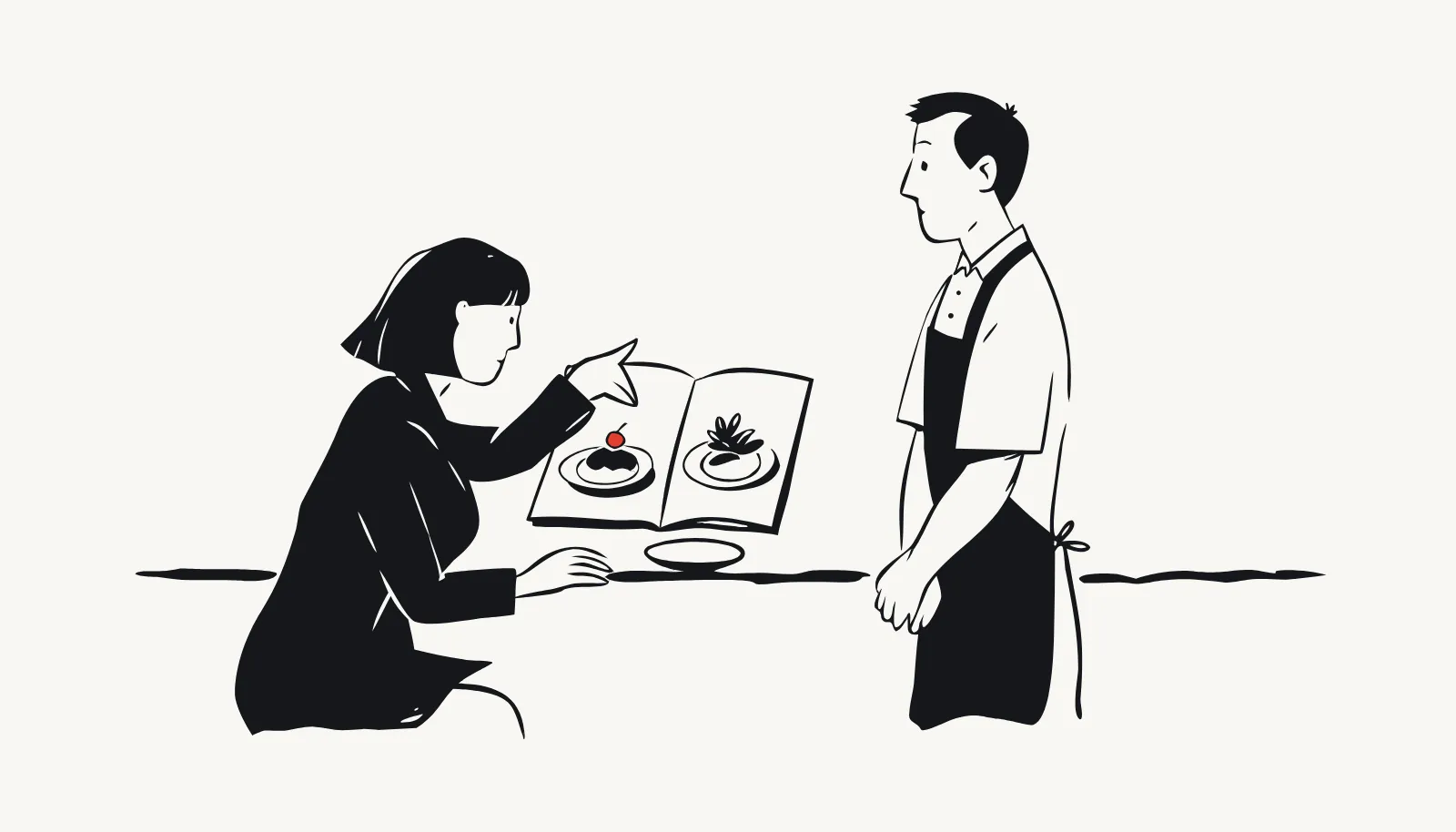
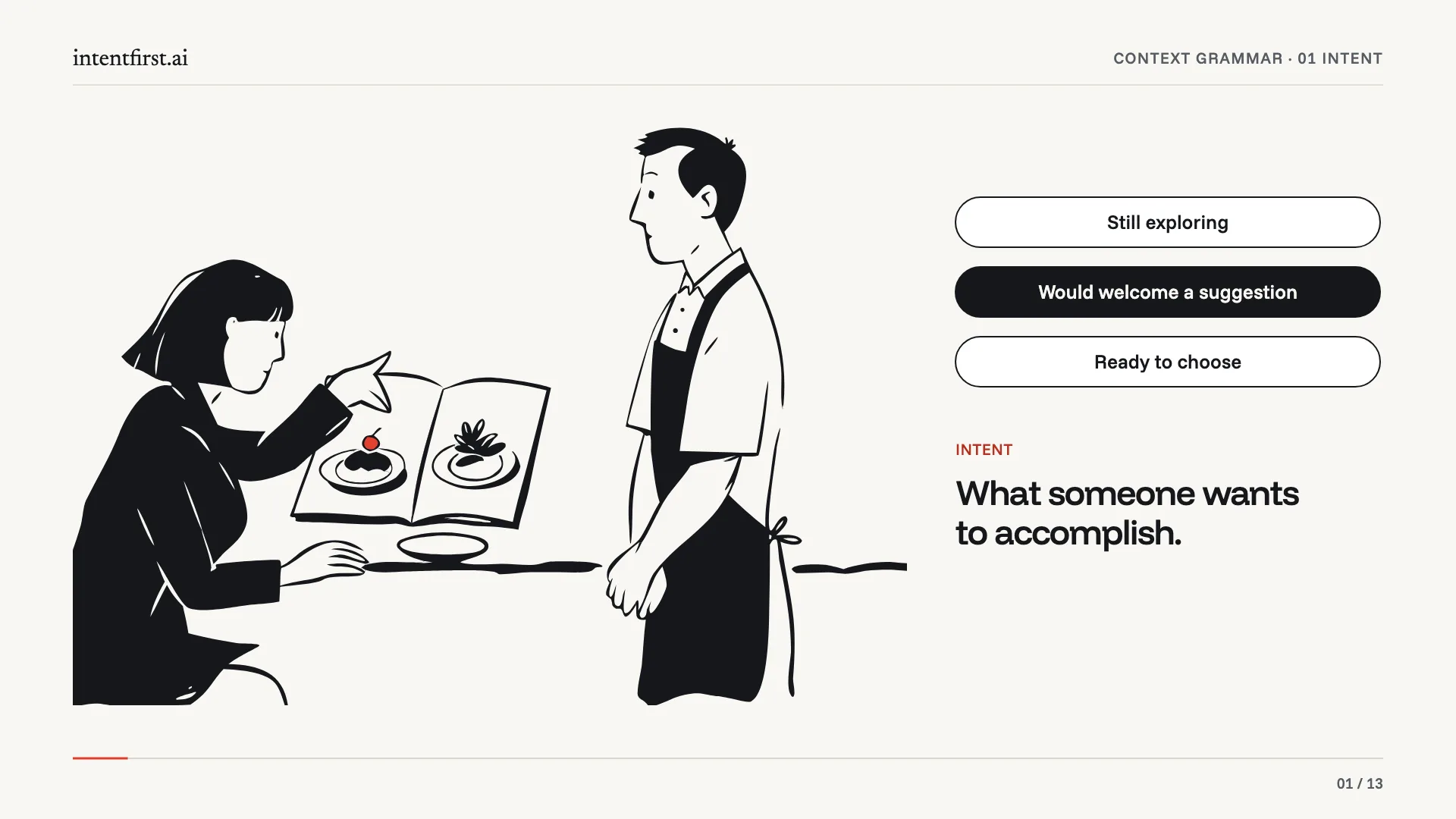
A good waiter does more than take an order. They notice whether you are still exploring, would welcome a suggestion, or are ready to choose. Intent is what someone wants to accomplish. Let’s see how an AI can notice that intention, without deciding it for them.
Two different questions
Imagine looking back and forth between two dishes. A waiter can see you comparing. But that does not mean you have chosen either one. There are two questions: how do we notice a possible need, and how far along is the person in deciding? A thoughtful offer is, “Would a comparison help?” Not, “I ordered that one for you.”
Four ways to notice
Context Grammar describes four ways an AI can notice an intention. Explicit: you ask. Active Implicit: your actions suggest a need. Passive Implicit: a familiar pattern offers a clue. And Ambient Implicit: the surrounding situation changes. These are ways of noticing, not four levels of permission. Let’s take them one at a time.
01 · Explicit
First, Explicit. You tell the waiter, “Something light, please. I need to leave in half an hour.” In an app, you might say, “Find my son some shoes for PE.” Speech, typing, and deliberate selections all give the assistant a direct request. But asking for suggestions is still different from authorizing a purchase.
02 · Active Implicit
Second, Active Implicit. You have not called the waiter, but keep switching between two dishes. The behavior offers a clue. Digitally, you might open the same size chart three times. The assistant can offer a side-by-side comparison. It should not assume that hesitation means consent, or that looking at a product means wanting to buy it.
03 · Passive Implicit
Third, Passive Implicit. At a regular family dinner, the host remembers that your family usually shares several small dishes. That familiar pattern can make a suggestion more useful. With information you have chosen to share, an AI might remember the meals your family enjoys. It can ask, “Your usual favorites, or something different tonight?” A habit is a starting point, not a fixed identity.
04 · Ambient Implicit
Fourth, Ambient Implicit. Something around you changes. The restaurant’s terrace closes as rain begins, so the host offers an indoor table. An AI might notice that a train delay affects a plan you shared. It can offer another route. The clue comes from the situation, not a new request from you. Moving your plans still depends on the permissions you set.
Noticing is not deciding
Now bring those clues into everyday life. Your child says their shoes feel tight. You might ask an AI assistant to find a pair, or start looking through size charts yourself. How does the AI realize you need help in the first place? And how far along are you in deciding what you actually want? Those are different questions: how it notices, and what stage your decision is in.
From a possibility to a decision
An intention can move through four stages. Latent: you have not yet considered a possibility. Exploratory: you are discovering what might work. Deliberating: you are comparing real options. Confirmed: you know what you want. Helpful support changes with each stage: a gentle invitation, room to explore, a clear comparison, then a confirmation of the action you choose.
A possibility you had not considered
A possibility can also bring people closer. A father loves the same manga as his children, but does not know the theme song from its anime. If the family has agreed to share those interests, an assistant could ask, “Would you like to hear the song they enjoy?” He says yes, and they listen together. The value is a new connection, not a prediction treated as a command.
Two questions, better support
Here is a simplified example of those two questions, not the full classification. Across: did you communicate directly, or did the AI observe a clue? Down: are you still deciding, or ready to act? A spoken request can be exploratory. An observed gesture can suggest readiness. Neither observation nor confidence grants permission. Keeping these questions separate helps the AI offer support without jumping to conclusions.
Notice. Ask. Understand together.
Back at your usual restaurant, you say, “Something different today.” The host does not bring your usual dish anyway. They ask what sounds good, then help you choose. AI should leave the same room to change your mind. An understanding you can correct is more useful than a prediction you cannot escape.
Keep exploring
Four ways to notice. Different stages of deciding. And always room for the person to guide what happens next. That is Intent. Read the Intent chapter for the full framework. Next, explore Situation Signals: how the same intention calls for different help as your body, surroundings, and available devices change.