AX Patterns
English audio
Read transcript
AX Patterns · Helpful behavior you can see and use
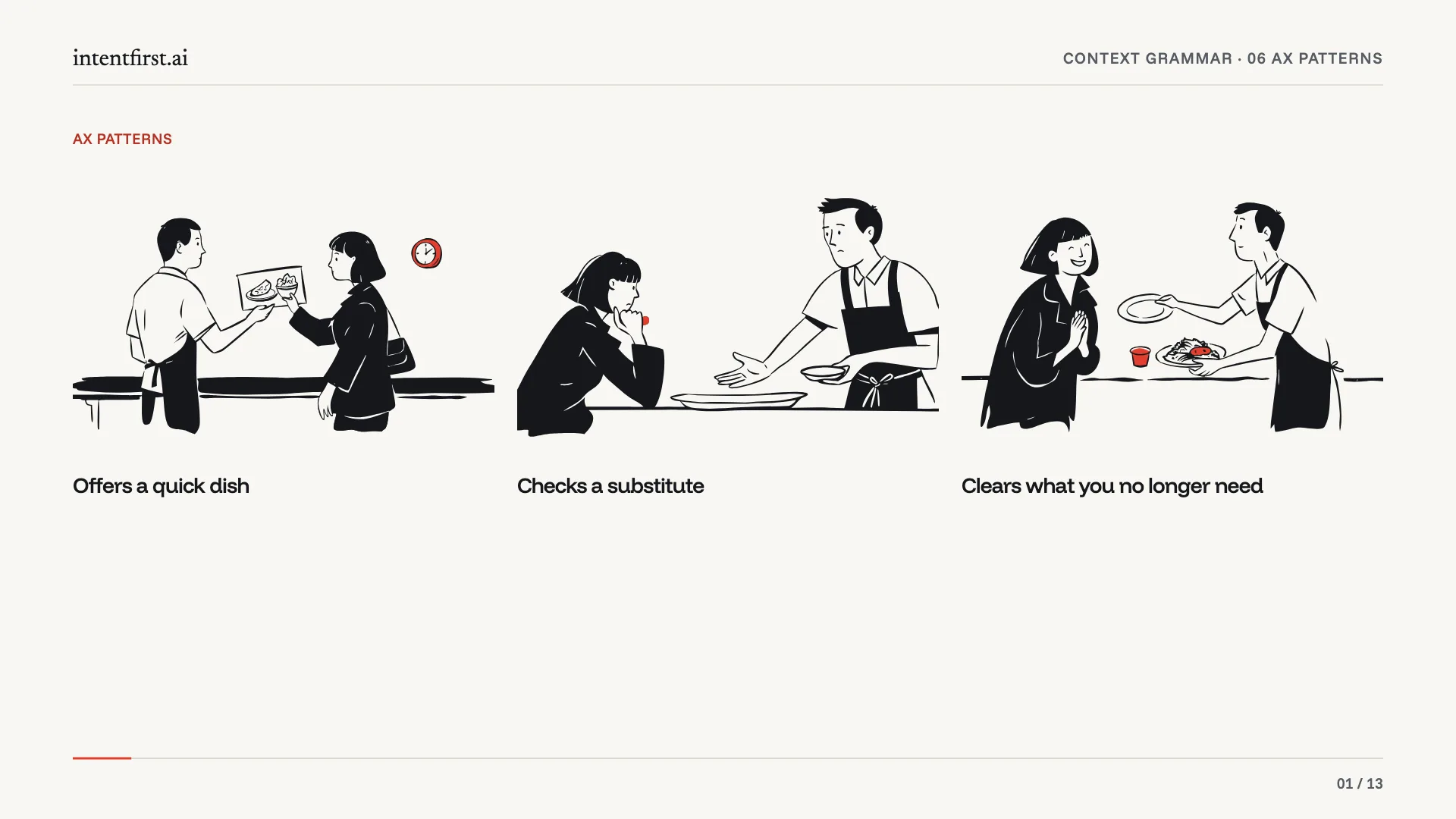
A host offers a quick dish when you are rushing, checks a substitute when your usual is unavailable, and clears the menu when you no longer need it. Care becomes tangible through actions. AI also needs to turn understanding into something you can use: a proposal, a question, or a handoff. AX Patterns describe these repeatable behaviors and the conditions in which they are useful.
Delegate / Ask for help / Adapt / Explain
Follow an assistant through a day of family shopping. Delegation helps you entrust a task. Escalation brings a question back when help or judgment is needed. Adaptation changes the experience with the situation. Enterprise patterns make decisions easier to inspect and adjust. The page groups twenty-three patterns under these four headings. We will see what they do in everyday use.
D1 Approval Gate / D2 Progressive Trust / D3 Proactive Nudge
Before ordering shoes, you can inspect and edit the size and price: Approval Gate. After reliable results and corrections, you may agree to delegate a familiar task with fewer checks: Progressive Trust. A quiet “Would you like to compare shoes?” on an unhurried weekend is a Proactive Nudge. Helpful delegation depends on both the offer and the moment it arrives.
D4 Omakase / D5 Substitution Modes / D6 Dynamic Friction
Omakase Mode handles routine supplies within an agreed scope. Substitution Modes specify what happens when an item is unavailable: Exact means the same item only; Flexible allows an alternative within your conditions; Exploring invites new options; Surprise delegates the choice within agreed limits. If an alternative carries a significant cost or consequence, Dynamic Friction brings that item back for confirmation.
E1 Confidence Signal / E2 Limitation Disclosure
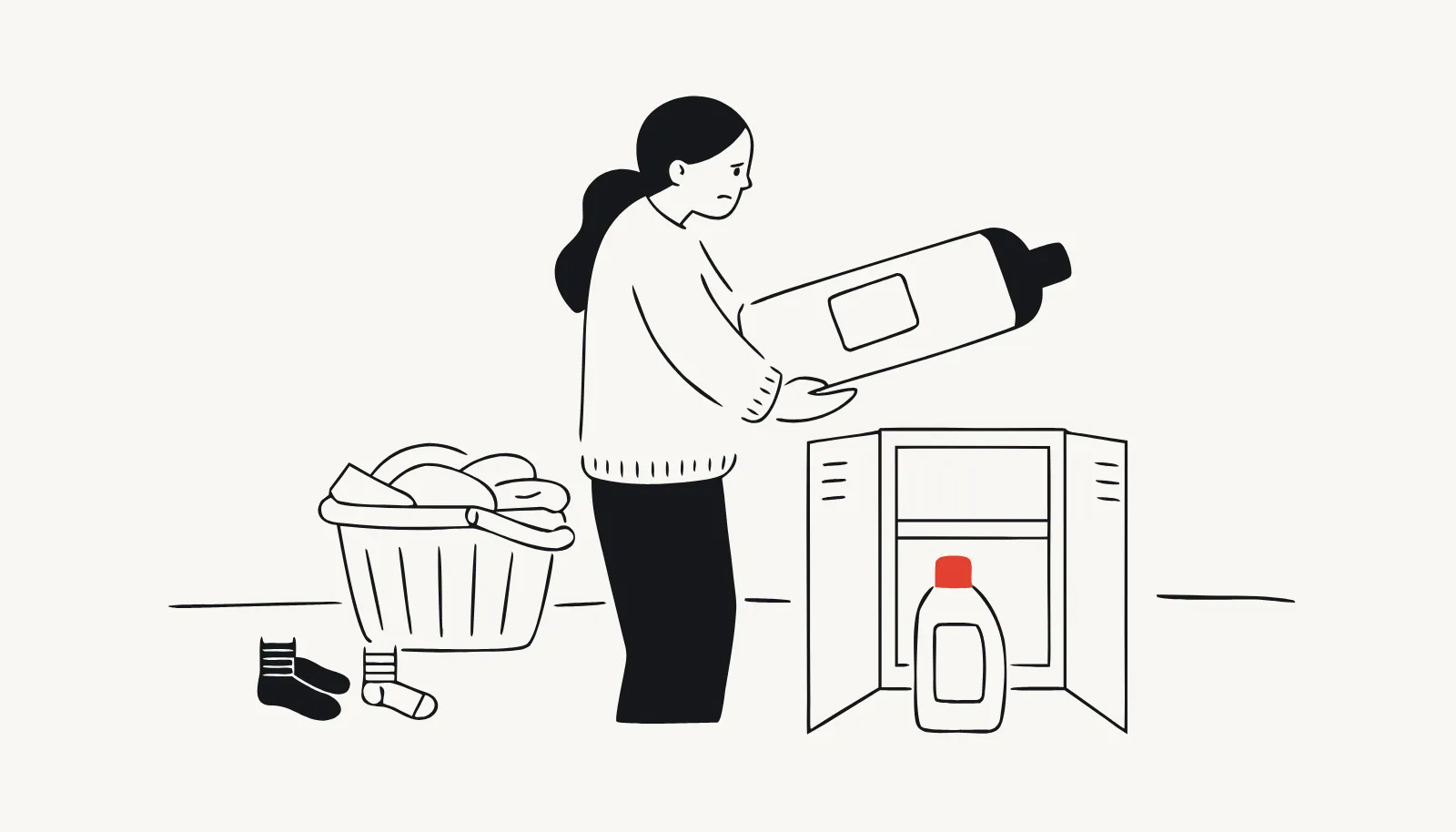
“This size looks promising, but we have not measured their feet.” Making that uncertainty visible is a Confidence Signal. “I cannot check this store’s stock. Would you like to contact the store?” is Limitation Disclosure: name the limit and offer a useful next step. The parent can then measure, inquire, or look elsewhere with a clearer understanding.
E3 Rollback / E4 Ambiguity Escalation / E5 Recovery
Rollback cancels an action where cancellation is actually possible. Ambiguity Escalation asks you to resolve a meaningful choice: “Lower price or earlier delivery?” If the assistant orders the wrong item, Trust Breach Recovery addresses the order and changes future handling. Each pattern should show a practical way forward, along with what will happen next.
A1 Form Factor Transform / A2 Cognitive Scaling / A3 Social-Aware Filtering
Put shoe pictures on the TV for the child, with prices and purchasing on the parent’s phone: Form Factor Transform. Start with one useful option when the parent is busy, and expand the comparison later: Cognitive Scaling. Keep private notifications off the shared display: Social-Aware Filtering. Together, these patterns create a shopping experience the family can use together.
A4 Disclosure Cascade / A5 Disposable Surface / A6 Care Architecture
Disclosure Cascade gives different audiences the permitted level of detail, such as a work summary instead of a full report. A Disposable Surface appears for choosing shoes and closes when that task is done. Care Architecture offers a welcome connection from interests people have agreed to share: “Your mother enjoyed this film too.” Each serves the person’s task or relationship.
A7 Live Recomposition / A8 Temporal Handoff
Rain changes the day’s plans. Live Recomposition rebuilds the itinerary around an indoor option while preserving the family’s priorities and rest time. Afterward, Temporal Handoff returns reviewed learning, such as keeping that afternoon break, to the family’s continuing memory. The experience can improve both today’s plan and the next trip.
X1 Reasoning Trace / X2 Inline Edit
“Why this hotel?” Reasoning Trace shows the actual basis: a short walk, an acceptable price, and room for the child’s rest break. Inline Edit lets you adjust the proposal there: “A little more budget is fine if it is closer to the station.” You can continue the conversation without starting the task again somewhere else.
X3 Autonomy Dial UI / X4 Source Attribution
Autonomy Dial UI makes delegation something you can actually adjust: routine supplies may be automated while hotel bookings need approval. Source Attribution shows where information came from and when it was checked. A note from yesterday and a current response from the hotel deserve different treatment. These Enterprise patterns are just as useful when a family wants to understand a decision.
Patterns work together in one experience
The morning’s routine order proceeds quietly. One item is missing, so the assistant checks the substitution setting. The available replacement costs much more, so that item waits. When the parent has a moment, it asks whether to skip it or choose another. Several patterns combine into one coherent interaction, rather than feeling like separate features competing for attention.
Design the behavior, from beginning to end
Inform, Recommend, Plan, Prepare, Act, Monitor, and Adapt describe the jobs these behaviors perform: tell you, suggest something, plan it, prepare it, carry it out, watch what happens, and adjust. A task does not have to visit every verb in order. Define when a behavior starts, what it does, and how it ends. That makes the interaction recognizable even across different devices.