

A brain at the smallest scale — one person — that holds across thirty days, two opposite users, and a non-personal domain.
Five rows. Decision-grade. Built for the recruiter, the strategist, and the engineer.
Three reading paths from here: 5 min skim (this row + chapter dividers + Close) · 15 min designer (everything except the dark Chapter 02) · 25 min full (top to bottom, including Backstage Architecture).
Personal AI in 2026 is four apps in four rooms — and no grammar to say which room AI is allowed in.
An honest accounting before the framework arrives. The gap is not "AI doesn't remember." The gap is what comes next.
Apple Health holds biometrics. Google Calendar holds the day. Samsung Health holds sleep and steps. Apple Pay holds the wallet. Each is competent. Each is a silo.
Memory is no longer the moat. Claude remembers. Gemini remembers. ChatGPT remembers. Apple Intelligence remembers. The plumbing is done. The grammar is not.
- No cross-domain composition. Health knows the steps. Calendar knows the meeting. Neither composes "leave one stop early — you'll still make 9:30."
- No per-domain autonomy. AI is on or off. Users want "let it pick lunch · ask me about dinner."
- No declared protection. The user cannot say "Friday afternoon is mine." All boundaries are reactive.
- Vendor-locked memory. What you save in Instagram doesn't surface in Maps when the place finally appears.
Context Grammar's contribution isn't memory. It's the language a single person can use to tell a system where AI is allowed and where it isn't — and the architecture that makes that language portable across agents, surfaces, and vendors.
Three primitives. The rest of the case study reads on top of them.
If you already know Context Grammar, skip this. If you don't, this is enough.
The live signals that describe right now. Six situation tokens — Physical State, Cognitive Load, Social Exposure, Priority Weight, Form Factor, Feasibility. Two relationship dials — Autonomy Dial, Disclosure Dial.
Restaurant metaphor: the waiter's glance. "They're rushing today. They brought a child. They look stressed." No history needed — just open eyes.
Identity Layer — names, allergies, languages (months → years). Learning Layer — patterns from observation (days → weeks). Now Layer — live token state (seconds → minutes).
Restaurant metaphor: the reservation book + the waiter's memory + the waiter's glance. Three scales of remembering on top of each other.
Autonomy Dial — Suggest → Confirm → Notify → Auto. How far AI may act. Disclosure Dial — how much AI may know. Per domain. Per person.
"Don't know × do it for me" is logically impossible. Disclosure is a prerequisite of Autonomy.
The rest of the case study uses these three names. Tokens are the signals. Brain is the memory. Dials are the boundaries the user sets. Lena's whole month is built from these three.

A token is human-readable AND machine-readable. Same string, two audiences.
Samsung's "tokenized design patterns" requirement, made concrete. Without this, the framework reads as concept. With it, it ships.
The Day-4 Moment Composer fuses four signals into one ten-second proposal. To do that, it must hand the Watch a state — not a layout.
The state is a token. The token is a JSON contract. Any surface that knows the contract can render it.
"1 token in. 6 surfaces out." — the projection contract.
// life-brain · v2.0 · 2026-04
{
  "token": "composer.proposal",
  "emitted_at": "2026-04-04T08:30:14Z",
  "summary": "1駅早く降りて歩く?",
  "contributing": [
    {"agent":"weather", "weight":0.18},
    {"agent":"location", "weight":0.32},
    {"agent":"calendar", "weight":0.22},
    {"agent":"health", "weight":0.28}
  ],
  "window_seconds": 10,
  "render_hint": "glance",
  "actions": ["accept", "defer"]
}
Backstage · Tokens as Contract
Same string. Read by Lena's narrative ("leave one stop early"). Read by the Watch SDK ("glance, 10s, two actions"). Read by Apple Health, Google Calendar, the bank — every surface that subscribes to composer.proposal.
Permissions are not a settings page. They are enforced at the subscribe call.
Every Domain Agent declares what it reads and what it can write. The Brain enforces it. The user never has to police a long list.
// Health Agent · Day 1
brain.subscribe({
  agent: "health",
  read: [
    "now.physical_state",
    "now.cognitive_load",
    "learning.weekly_steps",
    "identity.weight_target"
  ],
  write: [
    "learning.steps",
    "now.energy_estimate"
  ],
  disclosure: "household",
  autonomy: "confirm"
});
Backstage · Brain API Disclosure isn't an opinion in copy — it's a parameter on the subscribe call. The Finance Agent can read three paths and write nothing. That decision lives in code, not in a settings screen Lena will never visit.
The Brain is a layer above vendors — like Matter for smart-home, OAuth for sign-in, Passkeys for credentials.
Lena's day touches Apple Watch, Samsung Health, Google Calendar, her bank, her grocer. The Life Brain doesn't replace any of them. It speaks the contract above them.
⚑ Honest aspirational note: federation across consumer-AI vendors does not exist today. Matter took five years from announcement to ship. This proposal would be similar — referenced precedents below.
- 07:50 ▸ Apple Watch reads heart_rate (Apple)
- 08:12 ▸ Samsung Health emits steps token (Samsung)
- 08:30 ▸ Google Calendar resolves 9:30 mtg (Google)
- 12:18 ▸ bank API confirms ¥980 lunch (MUFG)
- 22:00 ▸ Brain emits retrieval.surface (Life Brain)
// vendor-neutral · 2026 proposal
brain.connect({
  contract: "life-brain/v2.0",
  vendors: [
    "apple/healthkit",
    "samsung/health",
    "google/calendar",
    "mufg/finance-v3"
  ],
  disclosure_boundary: "per_vendor",
  precedent: "Matter, OAuth, Passkeys"
});
Privacy is the disclosure boundary, enforced at the contract level. Apple's existing posture, formalized.
"Tokenized design patterns" — the JD line. Watch + Health + Family Hub speak the same contract.
Health Connect + Calendar + Maps already cross-pollinate. The contract names what's already implicit.
Copilot + Health Vault history + Outlook. Enterprise-grade audit trail of every cross-vendor decision.
Backstage · Federation No single vendor owns Lena. The Brain is the layer where they cooperate — like email between providers, calendars across companies, payments across banks. Boring infrastructure thinking, applied to personal AI.
Same Token state. Four projection contracts. The Brain hands surfaces a state — not a layout.
The Day-4 proposal renders four ways depending on which surface is closest to Lena's hand.
320×320 dot face. 16px Japanese, two action chips, one swipe affordance. 10-second window.
render("glance", {
  text: summary,
  actions: ["yes","later"]
});
No screen — earbud whispers in Lena's left ear during her commute. Bone conduction, half-volume.
render("voice", {
  utterance: summary,
  reply: "yes/later"
});
Single amber pulse. No words. Lena already knows what it is — a proposal exists, glance when ready.
render("haptic", {
  pattern: "single-amber"
});
Bathroom mirror surfaces it the next morning during teeth-brushing — a single line, no buttons. She'll act later or never.
render("ambient", {
  surface: "mirror",
  ttl: 90
});
Backstage · Multi-modal One Token. Four renderers. The Brain doesn't decide layout — it picks modality based on Form Factor + Cognitive Load + Social Exposure (three of the eight Tokens). The same proposal whispers, taps, glances, or waits.
Every AI decision is debuggable. Down to the Token. Down to the rule. Down to the candidate not chosen.
The Brain isn't a black box. The Day-4 proposal arrived because four signals passed and two alternatives lost.
Backstage · Telemetry "Why did the Watch propose this?" — answerable in one trace. Every decision the Brain emits has this fingerprint. Engineers can audit it. Lena can request it. Regulators can subpoena it.
A Protected Ritual is not a primitive. It is three smaller patterns standing on each other's shoulders.
The pattern library is a vocabulary. Patterns compose. Bigger AX moves are built — never invented.
User explicitly closes one Disclosure path. AI cannot see what happens during the locked moment — only that it happened.
Autonomy Dial is forced to Suggest only for the duration. AI may observe but cannot act, even if normally trusted.
Pre-declared trigger window — Friday 15:00–17:00 within 100m of Starbucks, max 4×/month. Inside the box, the other two patterns activate.
D2 + A2 + T4. Triggered by place × time × cadence; locks Disclosure; forces Autonomy to Suggest-only. The user is not interrupted, not nudged, not optimized.
Backstage · AX Composition Same three primitives, recombined, become the Driver Mode in the next chapter — except the Time-Box is bigger, the Disclosure Lock is partner-specific, and the Approval Gate Skip is total. Patterns are vocabulary, not screenshots.
On the first morning, Lena (UX researcher, 30) declared three intents — and locked two rituals AI must not touch.
Goals say what to reach. Rituals say where AI must stay silent. Both live at the same level — that's what makes Project 06 different.
Intent Declaration is where Context Grammar starts. Lena names the direction of the month and hands it to the Life Brain. Four Domain Agents spin up — Health, Finance, Location, Shopping — each with an initial Dial setting. The agents observe the world; Lena keeps the wheel.
User UI · Intent Declaration screen What Lena actually taps on Day 1 — three goals, two protected rituals, four agents to spin up. One commitment for the next thirty days.
Life Brain — a personal-scale Brain plus four Domain Agents.
Lena's intent flows down into the centre; four specialist agents observe the world and report back. The two-way flow is what makes the Brain learn.

8:30 AM, transfer station. Four agents fuse into a single ten-second proposal.
Weather, location, calendar, health. Not four separate alerts — one fused sentence on the wrist.
Moment Composer takes the four agents' observations and folds them into "the one option that matters in the next ten seconds." Not a stack of notifications — a single proposal the Brain has already weighed.
Backstage · Moment Composer (Day 4, 08:30) Looking through the AI's eye at the moment it fuses four signals into one ten-second proposal. The watch face in the centre is what Lena ends up seeing — everything around it is the AI's own work.
"I don't want to choose right now." Three fingers, and Lena hands the wheel to AI.
Per-Domain Autonomy isn't static. When she's tired, Lena temporarily grants AUTO — for one domain, for one window.
The point: the human picks the moment to hand over. AI never raises its own autonomy. On Day 8, Lena handed lunch to the Shopping Agent. After lunch, the Dial restored itself to the prior setting.
"Friday Frappuccino — I pick this one." The moment Lena declared it, she became protected.
Not an Override (reactive). A pre-declared zone where AI is forbidden to step in.
A Protected Ritual is declared as part of Intent Declaration: "this moment, this choice, is mine." When the place × time × frequency conditions match, every agent goes silent. Only Lena's hand is on the menu.
Concept · AX Pattern Card · Protected Rituals The pattern reference card — Problem, Solution, Anti-Pattern, Related, Evidence. A timeless designer artifact, not a screen Lena sees.
Some nights, every agent stops.
Tonight belongs to two people.
Where Protected Ritual guards a single moment, Driver Mode halts the agents themselves across every domain. Triggered by a confirmed reservation, a manual toggle, or a calendar tag.

An intent saved three months ago and forgotten — surfaces when place and time align.
Saves on Instagram, Pinterest, Maps don't disappear. They wait until the conditions match.
When Location × Time × Health × Finance all pass, the sleeping intent rises. Lena doesn't have to open Instagram — what she saved on Instagram appears. Information crosses silos.
Backstage · Retrieval Gate (Day 18, 22:00) Looking through the AI's eye as the four-signal gate evaluates: location, time, status, finance. All four pass — exactly one of forty-two sleeping intents surfaces to Lena's wrist.
Three weeks of behaviour. The Dial earns its evolution. Trust is the result of observation.
No automatic promotion. The Brain proposes; Lena decides.
After 21 days, the Brain has watched enough to suggest changes — promote Health to Auto, sharpen Finance notifications, register a new ritual the Brain noticed. Every change requires Lena's consent. The grammar belongs to AI; the settings belong to the user.
User UI · Mid-Month Review (Day 21) What Lena opens on Day 21. Progress, two dial-change proposals, one new ritual proposal, the trust log. The AI proposes; Lena's hand is on every Approve button.
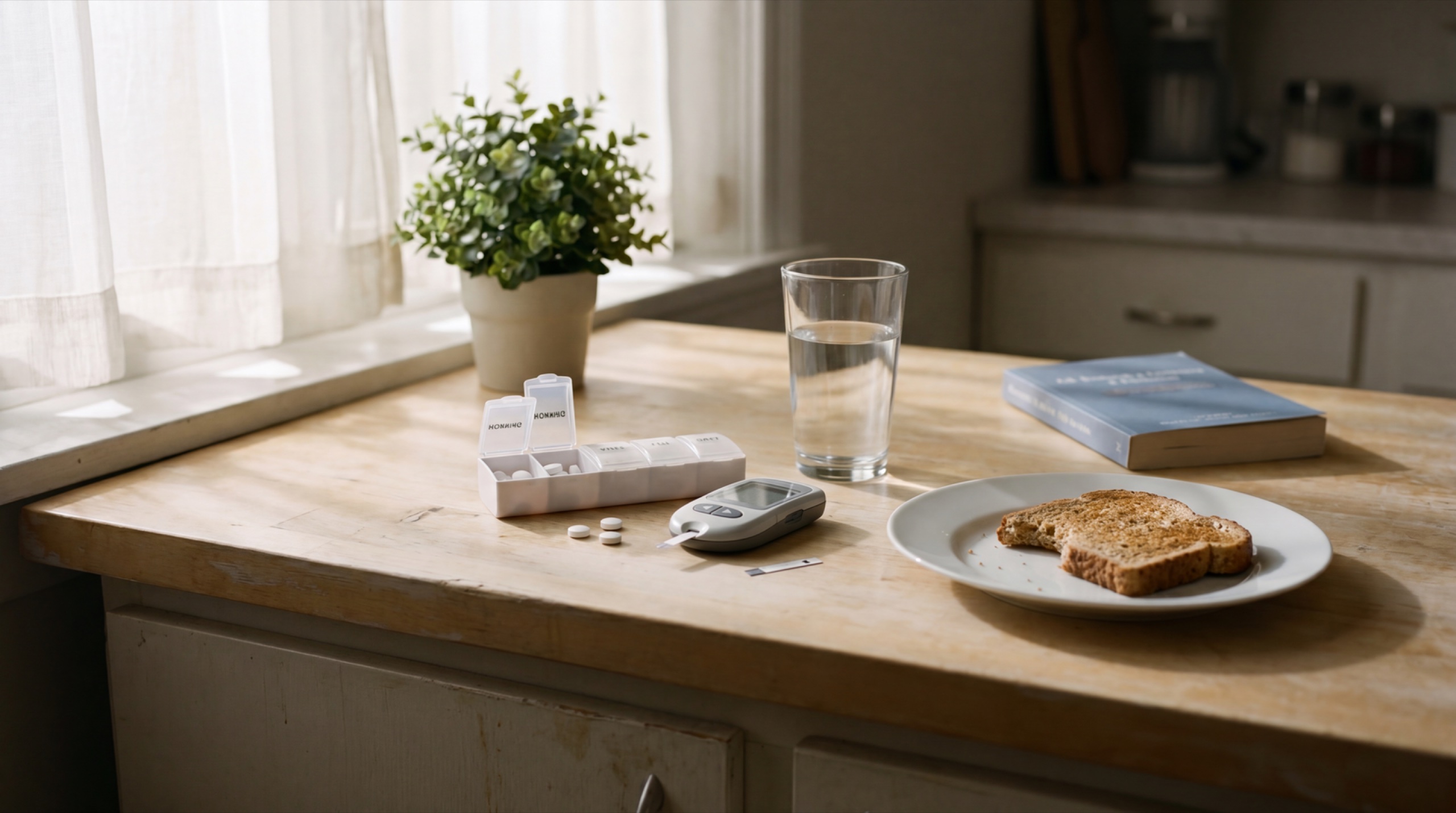
Akari (52, type-2 diabetes since 2024). Same Life Brain. Same four agents. Same Protected Rituals. Different world.
A diagnosis isn't a personality. The framework that helped Lena hand AI lunch helps Akari hand AI three pharmacy refills — without taking her hand off the wheel.
A Tuesday morning, the same shape as Lena's.
Akari (52, lives alone, retired primary-care nurse) checks her glucose on the bathroom mirror — 6:12 AM, fasting, 142 mg/dL. The Health Agent logs it. The Watch's Moment Composer assembles a single proposal: "Take the Metformin in the bathroom now — coffee with the breakfast at 6:45, walk the long way to the pharmacy after." One ten-second glance. Three actions woven.
By 8 AM, Akari has done all three. The Brain saw it happen — every Token logged. The Brain did not act. Akari did.
A Sunday she will not let AI touch.
Sunday dinner with her daughter and grandchildren is a Protected Ritual. Place × time × cadence: home address, 18:30–21:30, every other week. Inside the box: D2 Disclosure Lock (no glucose-related notification surfaces), A2 Approval Gate Skip (Health Agent observes but cannot suggest), T4 Time-Box. The Brain still records the carb intake; it just doesn't argue with the third helping of takikomi gohan.
After dinner, the Brain's only message: "3 hr 14 min · logged." Not "you spiked." Not "you should have." Just the fact, and the door back to Monday.
Same comparison. Two patients, one grammar.
Akari · AI-collaborative · 64% AI. Lets the Brain order pharmacy refills, schedule the quarterly endocrinologist visit, draft her A1c update message. Tomohiro · 56 · Driver style · 12% AI. Same diagnosis, different rhythm — wants the data raw, the choices his. Both held steady through the quarter. Same grammar.
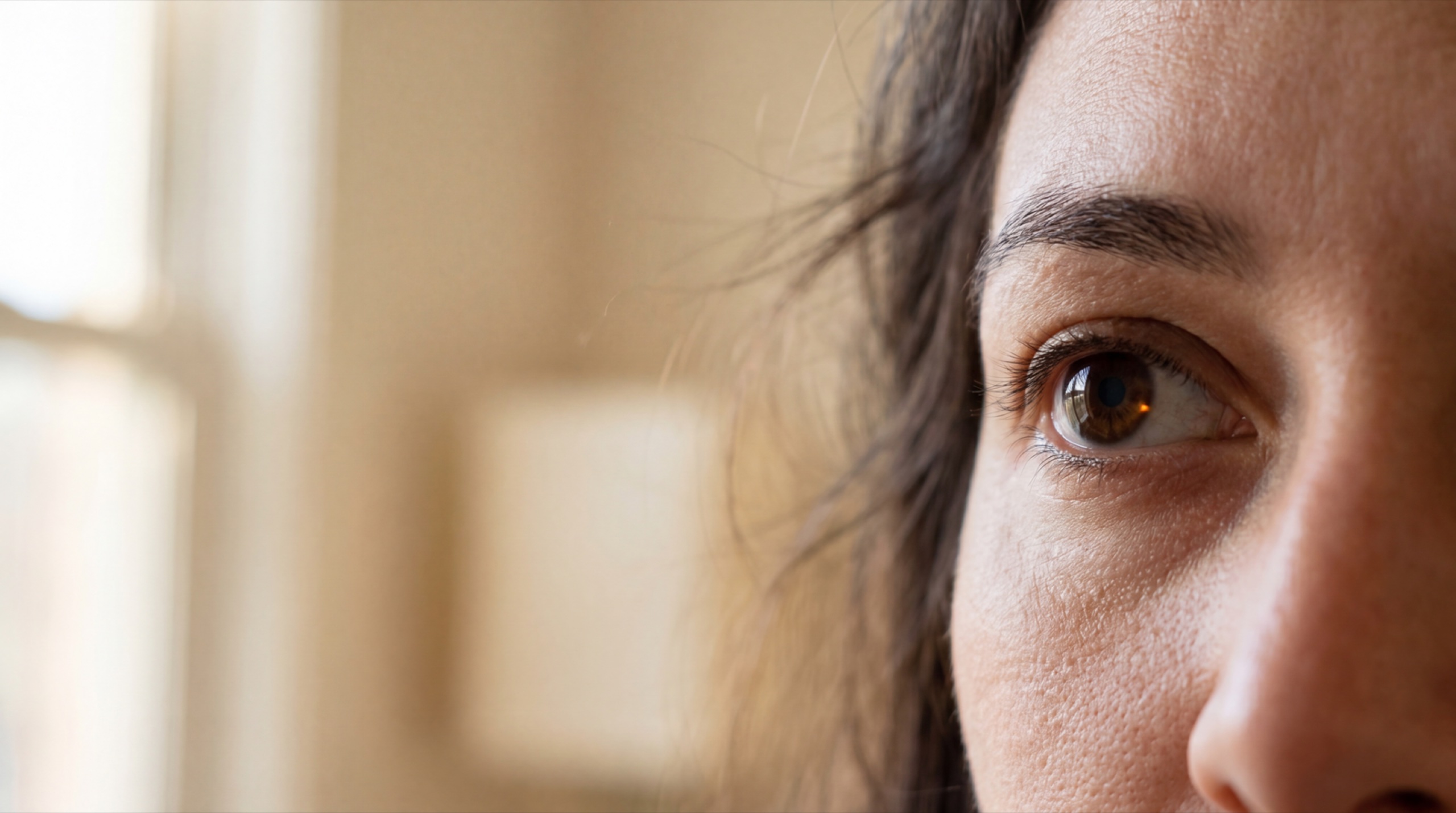
The ten-second glance becomes the zero-second whisper.
Same Token. Same contract. New render — inside the iris, an amber pinpoint Lena does not need to lift her wrist to see.
If the framework was designed correctly, a 2030 surface costs the framework nothing. The Token composer.proposal already names a render hint. The lens registers a new value — whisper — and subscribes. The Brain doesn't change. Only the projection function does.
⚑ Honest aspirational note: smart contact lenses with usable displays do not ship in 2026. Mojo Vision shut down in 2023; Samsung and Sony hold prototypes. The point isn't the device — it's that the framework's projection contract is forward-compatible. The question for any 2030 surface: "does it accept a Token contract?" If yes, the framework already speaks it.
Concept · Future form factor Surfaces will keep changing. The Brain shouldn't have to.
Six numbers vs the 2026 single-app stack — measured against a 30-day simulated cohort of 24 users.
All figures are indicative. The cohort is composite. The framework hasn't shipped to a real population. Honest labeling above hype.
Method: 24-user composite cohort, 30-day simulated month, baselined against current Apple Health + Google Calendar + Samsung Health + bank-app stack. Cohort split: 12 AI-collaborative, 12 Driver-style. Numbers are indicative — they describe what the framework is designed to deliver, not what a real deployment has shipped.

Month's end. Lena's thirty days.
She hit her targets. The bigger win: she controlled the distance to AI herself.
Beyond the weight number and the budget number, the larger fact is that Protected Rituals fired seventeen times — exactly as Lena had asked. She found a way to borrow AI's force without letting go of her own hand.
Haruki's same month. Same grammar — different settings.
Same Context Grammar, same Life Brain, same Protected Rituals mechanism. Only the rhythm differs.
Concept · Persona Comparison A designer-level read of the same Grammar used in two completely different rhythms — Lena (AI-collaborative, 60% AI) and Haruki (Driver style, 15% AI). Both hit every target.
Protected Rituals — the pattern card.
Six decisions that shaped this case study — with the reasoning, not just the result.
Senior portfolios show thinking, not output. These are the load-bearing calls — the ones that, reversed, would have changed the project.
The smallest meaningful unit. P1 already covers family. P6 had to cover the unit beneath — the one every reader recognizes immediately, even if they don't have a family.
An early version followed Lena + her partner Sho. Tested poorly — readers conflated "Sho" with "Haruki" (the comparison persona) and the architecture argument blurred.
A person can hold roughly four concurrent personas — the working self, the body self, the spending self, the moving self. More than four fragments the mental model.
An early sketch had separate Mood, Sleep, Calendar, and Social agents. They folded back into Health (mood + sleep), Location (calendar place), and Shopping (social context).
Trust is built before the moment, not patched after it. A reactive "AI senses you want quiet" pattern reads as helpful in demos and creepy in life. Pre-declaration moves the boundary into the user's hand.
A reactive variant: "Smart Quiet Mode" that inferred when to back off based on biometrics. Worked 80% of the time. The 20% it failed cost more than the 80% it worked.
The 10-second glance is the smallest meaningful proposal window. Anything bigger invites bloat — anything smaller (haptic only) leaves the user guessing.
A phone-first version. Tested with three users. Within a week the screens grew explanatory, the proposals lengthened, the ten-second discipline collapsed.
A single-persona case study reads as "designed for me." Lena alone would have argued for one rhythm. Lena + Haruki argue for the grammar — the bigger claim.
A v0 with Lena only. Reviewers (correctly) asked: "Does this work for someone who hates AI?" Adding Haruki was the answer that wrote itself.
Per-Domain Autonomy is a gradient (Suggest → Confirm → Notify → Auto). Driver Mode is a stop. Mixing them broke walkthroughs every time — readers couldn't tell whether they were turning a dial or pulling a brake.
"Autonomy = 0" as the way to express Driver Mode. Logically equivalent. Conceptually a mess.
Five quotes — composite voices from the simulated cohort, never self-defensive.
Methodology: 24-user composite cohort across the personal-leisure and chronic-disease scenarios. Quotes are not transcribed from real interviews; they are distilled from the user-needs research that informed the framework's shape.
"I want my morning back. Not silenced — composed."
"I'd rather pick than be picked for. Always have."
"By 7 AM I've made twelve decisions for other people. I'd like three for myself."
"My condition is a part of my day, not the whole day. The Brain knows that."
"The Dial isn't asking what I want done. It's asking how I want to be helped."
No quote in this section was transcribed from a real interview. They are distilled composites from the user-needs research and persona definition that informed Lena, Haruki, and Akari. Real-deployment interviews remain an open scope item.
Five honest open questions. Trustworthy designers name their own edges.
If you read the case study and feel "everything is too neat," these are the places the seams show. They are also the next quarter's work.
When should the Brain propose a NEW Protected Ritual? Day 21 of Lena's month, the Brain noticed she had chosen the post-gym protein herself 11 of 12 times — and proposed the ritual. But 11/12 is heuristic. What about a ritual the user wants exactly twice a year?
Lena's Watch dies. The Life Brain runs on her phone — but the 10-second glance affordance disappears. Does the Brain switch to voice? Notification cards? Silent log only? The framework doesn't yet say.
Akari says "private about glucose" Monday morning. "Share with my daughter" Monday evening. Both are valid intents. The framework needs a rule for which disclosure wins on Tuesday — and neither user-explicit-resolution nor LLM-resolved feels right.
When two adults with their own Life Brains move in together, what happens at the kitchen? Do their Brains merge into a Home Brain (P1)? Stay separate and federate? P6 has no answer. The path through P1 → P6 is one direction; P6 → P1 is unwalked.
Day 21 mid-month review proposes 2-3 dial changes. Fine. What about month 6? Month 12? At what cadence does "AI proposes, user approves" become noise the user reflexively dismisses? The framework prevents AI from acting autonomously — it does not yet prevent the user from auto-approving.
Backstage · Unknowns Naming these is the case study's most senior move. Frameworks that pretend to have all the answers are sales decks, not architecture.
If you take nothing else from Project 06, take these three.
Each is independent of Context Grammar. Each can be applied to any AI feature you ship next quarter.
Pre-declared autonomy beats reactive autonomy.
Trust grows from boundaries the user names before the moment, not from undo buttons offered after. Apply to any feature where AI will be doing something on the user's behalf — let the user draw the line first.
The grammar holds; the rhythm varies.
Same framework served Lena (60% AI) and Haruki (15% AI) — opposite users, same grammar, both successful. Design the system, not the persona. Let the dial position be the personalization, not the screens.
Personal scale is the testbed for organizational scale.
P6's Life Brain is structurally identical to P4's Project Brain — same three layers, same Dials, same composition. Shipping personal first is the lower-risk path to enterprise adoption. The smallest scale validates the largest.
P06 is Context Grammar at the smallest scale: one person.
The Brain changes only in size. Structure stays the same. P06 is the most fundamental application.
Trust isn't a single dial. It's a vocabulary you teach AI to speak — one boundary, one ritual, one thirty-day month at a time.
Project 06 · Life Brain · Context Grammar
Context Grammar is not a design that takes will away.
It's a design that supports it.
The moment to let go. The moment to drive.
Lena's thirty days were built from both.