Project 02 · Family Trip
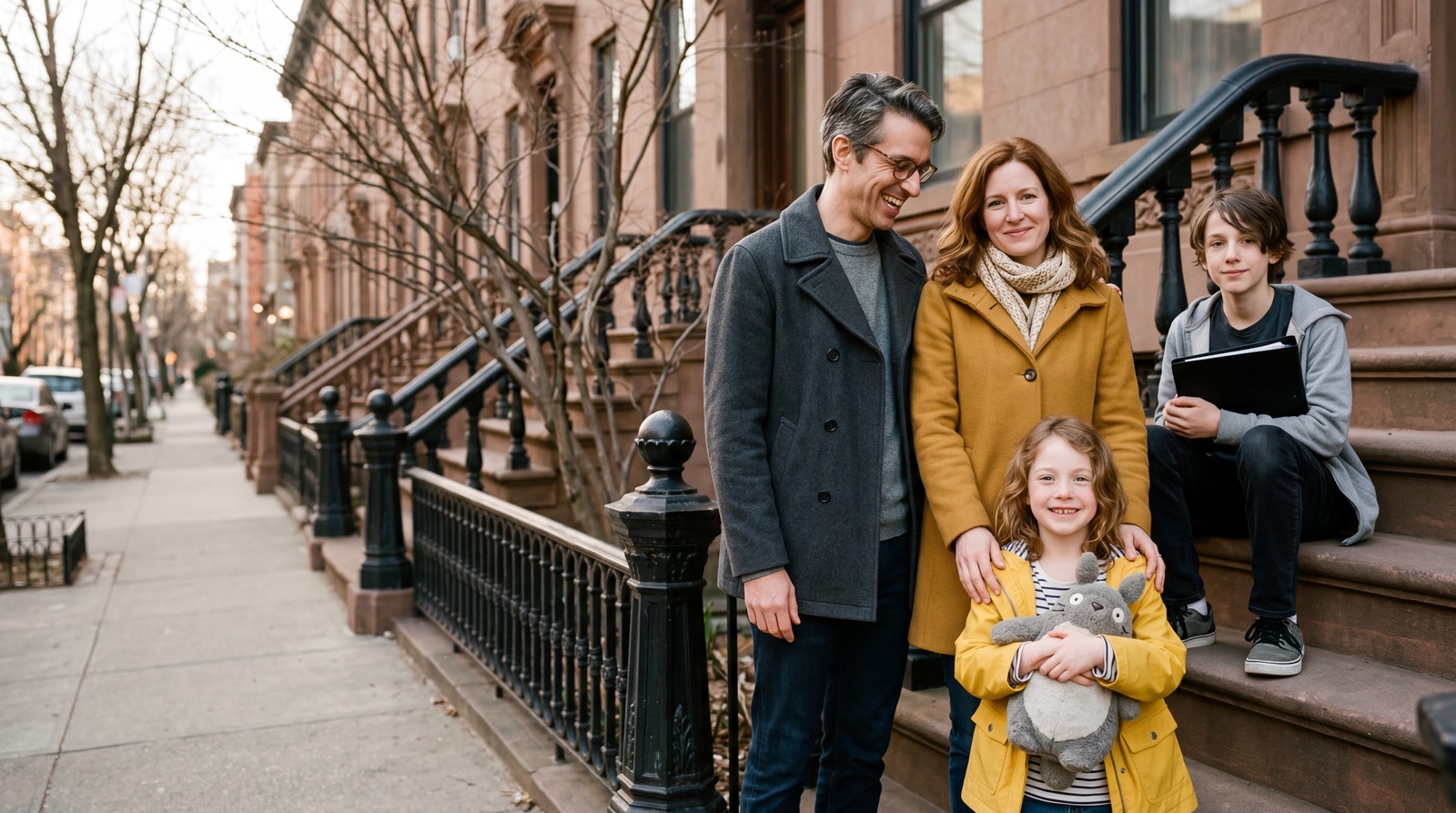
Rachel Stern (mom, 41) was exactly the kind of person AI travel tools were built for. She used ChatGPT for itinerary drafts, Mindtrip.ai for day-by-day pacing, Google Maps for offline transit, Apple Wallet for tickets, a shared Notion for the family. Five tools. Five memories. None of them knew each other.
The Ghibli Museum lottery opened the 10th of every month. Pokémon Center Mega Tokyo did not take reservations. The sword forge in Kameoka held three slots a week. The Toei Studio Demon Slayer collab depended on a date the studio had not yet published. Five planning surfaces. None of them told the others what they had learned.
Every morning of the planning month, Rachel re-explained her family to a different model: Eli was 13, just had his Bar Mitzvah, loved Demon Slayer and Pokémon, anxious about being the oldest. Maya was 9, fixated on Totoro since age 4, had a stuffed Totoro named "Mae." David read novels and pretended he didn't watch anime. The kids overlapped on Ghibli but split on everything else.
The friction wasn't the AI. The friction was that Rachel was the integration layer. She was the Brain. That is what Context Grammar set out to give back to her.
Two years ago the Sterns went to Europe — a completely different continent, different languages, different everything. Rachel planned it. Spreadsheets, group chats, 47 browser tabs. She held the whole trip in her head: who eats what, when Maya tires, what Eli will and won't do, how to reorder the itinerary mid-day when something falls apart. She was the integration layer.
In June 2025, Home Brain arrived. It didn't replace Rachel. It started learning her family — the allergies, the Saturday rhythms, who skips breakfast, who needs quiet after loud. Three months later, it knew the Sterns.
Then the Japan trip came up. A 14-day trip is a different context — new currency, new transit, a city the Brain has never seen. Loading all of that into the Home Brain would bloat it. Loading none of it leaves the trip context-blind. Context Grammar's answer: a Disposable Brain. Born for the trip, inheriting what matters from Home Brain, learning inside the trip, returning what's worth keeping, then dissolving. Same shape. Different lifespan.
The Home Brain is permanent. The trip is not. Loading 14 days of currency conversions, hotel codes, and museum bookings into the Home Brain would either bloat it or pollute it. Loading none of it leaves the trip context-blind. Context Grammar's structural answer is a four-stage lifecycle — born for the trip, learning inside it, returning what's worth keeping, dissolving the rest.
Home Brain forks a curated subset into a new Brain instance. Names, allergies, sibling dynamics, languages, baseline Disclosure profile — all travel forward. Mortgage, fridge inventory, school calendar do not.
The Brain accumulates trip-local patterns. Eli skips breakfast on day 3. Maya can sit still for 90 minutes if her hands are working. The family's pace flips after 3 PM. Sakura blooms 6 days early — the Now Layer rebuilds nightly, the Trip Learning Layer accumulates.
Distillation. 14 days of observation compress into a small set of retained learnings. "Eli is a maker" goes back into the Home Brain's Identity Layer. "Maya works with her hands" goes into Learning. Receipts, hotel codes, train schedules stay in the Disposable Brain — they will dissolve.
The Disposable Brain instance closes. Trip-local context is gone. The Home Brain keeps what was returned and nothing else. Photos and itineraries remain queryable from the Graduated Archive — they surface only on anniversaries, not in daily search.
Backstage view Same shape as the Home Brain — three layers, eight Tokens, two Dials. Different lifespan. The structural answer to "where does trip context belong?" is: somewhere it can dissolve cleanly.
What does the Home Brain hand over at brain.fork()? Not raw text. Not a settings page. A typed schema — eight Tokens and two Dials — readable by humans and parseable by every surface that consumes it.
Six situation Tokens describe the family's state — what's true about them, this trip. Two Dials describe the relationship — how much each member lets the AI know, and how much they let it act on its own. Together they are the contract every trip-time surface speaks against.
Rachel can re-explain her family to ChatGPT every morning. She cannot re-explain her family to a fridge, a hotel TV, an airport check-in kiosk, and a JR train carriage display every morning. The schema is what scales the explanation across surfaces.
The schema is versioned. A 2026 hotel TV running v1.2 still receives a graceful projection from a 2028 Brain running v2.0. New Tokens are additive; deprecated ones include a fallback contract.
// brain.fork() — Disposable Brain born for trip-2026-03-japan
// Source: home-brain.stern · Schema v1.2 · 2026-03-14

{
  "identity": {
    "members": [
      { "name": "David",  "role": "parent",  "age": 42 },
      { "name": "Rachel", "role": "parent",  "age": 41 },
      { "name": "Eli",    "role": "child",   "age": 13,
        "interests": ["anime", "trading-cards", "crafting"] },
      { "name": "Maya",   "role": "child",   "age": 9,
        "interests": ["animation", "animals", "craft"] }
    ],
    "languages": ["en"],
    "sibling-care": "2+2"  // Maya gets a parallel hour for every Eli hour
  },

  "tokens": {
    // Six situation Tokens (live, recompute per moment)
    "physical-state":    "travel-day-jet-lag-expected",
    "cognitive-load":    "high-on-arrival, drops-by-day-3",
    "social-exposure":   "family-of-four, public-spaces, photographed",
    "priority-weight":   "experience > logistics, eli-bar-mitzvah-marker",
    "form-factor":       ["phone", "hotel-tv", "jr-carriage", "watch"],
    "feasibility":       "USD-budget-set, JR-pass-procured, lottery-confirmed"
  },

  "dials": {
    // Per-domain, per-audience disclosure profile
    "disclosure": {
      "ny-grandparents":   "full-share + daily-photo-digest",
      "eli-classmates":    "curated-highlights, bar-mitzvah-omitted",
      "synagogue-comm":    "thumbnails + 1-line-caption"
    },
    "autonomy": {
      "transit":           "auto",        // book without asking
      "food":              "confirm",     // suggest, family decides
      "experiences":       "confirm",
      "medical":           "suggest"      // always ask
    }
  },

  "lifecycle": {
    "born":    "2026-03-14T22:00-05:00",
    "expires": "2026-04-30T00:00-05:00",
    "return-contract": ["identity-deltas", "learning-deltas"],
    "dissolve-contract": "clear-trip-now-and-trip-learning"
  }
}
Backstage view Every surface in the trip — phone, hotel TV, train display, group chat — reads against this schema. Rachel never re-explains her family. The Brain is the explanation.
The missing layer between "family memory" and "phone card" is a Brain API. Every renderer asks the same small set of questions: who is asking, what surface is rendering, what is the current Token state, and what is the allowed Autonomy ceiling? The response is a contract the surface can render without learning the whole family.
A renderer reads the current Token state: location, load, priority, form factor, feasibility, Disclosure, Autonomy.
The Brain resolves audience and role. David can see budget breach. Eli sees three pins. JR sees party-state only.
The API emits a typed payload. Phone, hotel TV, train display, and chat decide layout locally.
This is why the case can show many UI surfaces without inventing many products. The product is the contract. The screens are projections.
// Brain API · runtime read for Day 9 sakura recomposition
brain.resolve({
  surface:  "iphone.today-card",
  viewer:   "david",
  moment:   "2026-03-23T07:14+09:00",
  tokens:   ["feasibility", "priority-weight", "form-factor"],
  dials:    { disclosure: "parent", autonomy: "confirm" }
})
→ {
  kind:      "approval.required",
  reason:    "sakura-peak-moved-six-days-early",
  held:      ["day-10-forge", "maya-kimono-anchor"],
  syncTo:    ["hotel-tv", "jr-pass-app", "group-chat", "hotel-concierge"],
  requires:  ["david-approval", "rachel-approval"]
}
Backstage view This is the runtime contract behind the visible screens. It keeps the UI honest: each surface receives only what its audience, device, and autonomy level can carry.
A two-week trip touches eight or more vendors — maps, transit, lodging, ticketing, in-room TV, photo backup, museum lotteries, language. None of them share memory. Today, Rachel is the integration layer. The proposal here is that the Brain becomes that layer — not as a service from one vendor, but as a vendor-neutral contract every surface speaks against. Like Matter for smart-home, OAuth for credentials, Passkeys for sign-in.
Aspirational labeling: the federation contract described below does not exist in 2026. Matter took ~5 years from announcement to ship. A Brain federation would likely be similar. Naming the precedent is what makes this concrete instead of magical.
Privacy on-device + cross-Apple-surface continuity. Apple Intelligence as the local Brain runtime — no cloud round-trip for family routines.
Maps + Photos + Gemini already touch this trip. Federation makes their stack complete without forcing the family off Apple devices.
Hotel TVs are mostly Samsung. Tokenized DS adoption gives in-room TVs a coherent agentic story without owning the user's Brain.
Copilot in Bookings, Outlook, and Teams already maps to corporate-offsite use (CH 06). Same federation, different domain.
Backstage view Eight vendors, one Brain. The federation contract is what stops Rachel from being the integration layer — and what lets each vendor compete on craft instead of on lock-in.
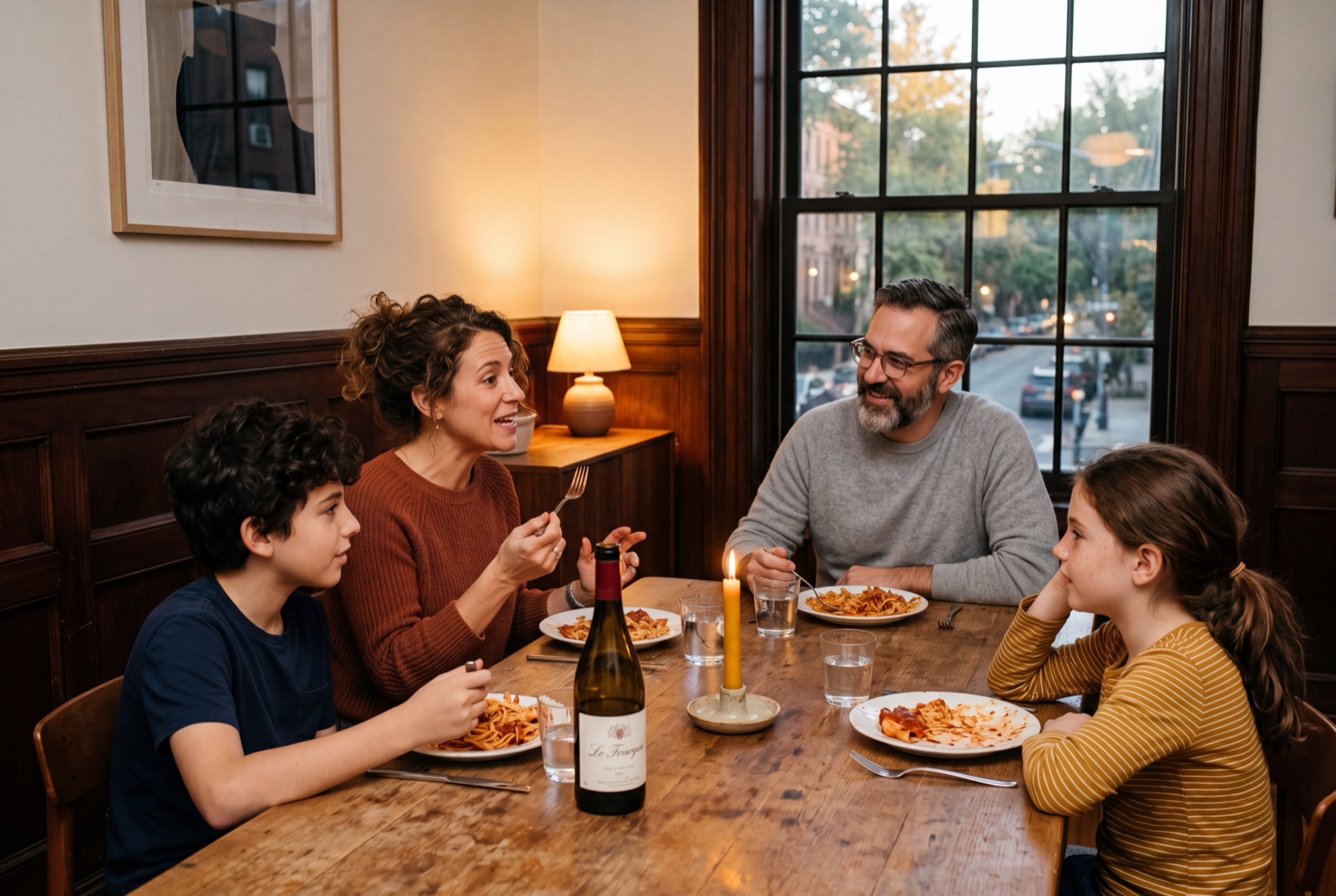
Friday night. The four Sterns are around the dining table in their Park Slope brownstone. Between the main course and dessert, Rachel turns to the family: "For Eli's Bar Mitzvah celebration, what about the four of us going to Japan in the spring?" Eli puts his chopsticks down. Maya: "Like, the real Ghibli place?" David nods.
Rachel turns to the Google Nest on the kitchen counter and says it once, plainly: "Hey, we'd like to plan a 2-week trip in spring for Eli's Bar Mitzvah celebration in Japan, all four of us going."
The Nest's LED ring pulses for a second. The reply, in Japanese: 「了解しました。週末までに下準備しておきます。」 ("Understood. I'll have things ready by the weekend.") That is the entire interaction. No screen. No app. No interface. Behind the family, the Home Brain has already forked a Trip Brain — Identity Layer inherited, intent stored, prep window booked through Saturday morning. The Sterns return to dessert.
Backstage · Brain Fork A 1-second LED pulse is the only thing the family sees. The fork happens silently in the background. The Trip Brain inherits identity, stores the intent, and gives itself until the next morning to prepare its first proper dashboard.
Saturday morning. David pours coffee, opens the MacBook on the kitchen island. The Trip Brain dashboard is already running. Overnight, in the eight hours since dinner, the Brain has done the prep it promised:
In the corner of the dashboard, the Brain has a single, careful question: "Is there anything Eli's friends are into right now? I might not have it in my memory yet."
David thinks for a second. "Eli's friends are into Jujutsu Kaisen lately. He hasn't said much, but I notice he checks the manga every week."
The Brain's reply: "Noted. I'll check the Jujutsu Kaisen Harajuku collab café for March operating dates. I'll keep this off Eli's view — surprise." One sentence at the dinner table on Friday. Eight hours of prep on Friday night. One question on Saturday morning. The Brain learns the things it doesn't know by asking the family — not by guessing.
User UI · MacBook · Trip Brain dashboard Left column — what the Brain already has (four people, sizes, allergies, known interests). Right column — the open questions (Bar Mitzvah dates, school break window, three flight options). One careful question at the bottom: what are Eli's friends into?
With Jujutsu Kaisen added to its memory of Eli, the Trip Brain shows Rachel a different kind of map: a Venn diagram of the family's interests. Family-wide — Studio Ghibli, Japanese food, matcha. Eli + David — Jujutsu Kaisen and martial-arts manga. Maya + Rachel — craft and traditional sweets. Eli + Maya — Pokémon. And then the singletons: Maya alone (cat cafés), Eli alone (the Demon Slayer forge — held as a surprise), David alone (literary fiction), Rachel alone (gardens and photography).
This map is the foundation of every later decision. The TV night skeletons (CH 02 · 14), the Care Architecture · 2+2 contract, the "spoiler view" the parents see of the kids' guidebooks, the surprise the forge eventually becomes — all of it descends from this one chart. Same family. Different overlaps. The Brain plans around all of them at once.
Concept · Family interest map Center: family-wide interests. Pair regions: shared between two members. Outer rings: each person's solo interests. Eli's "demon-slayer forge" item is held in a hidden layer the parents can see and the kids cannot.
User UI · iPhone (Eli) Photo-card deck. Tap yes, maybe, or skip. No prices. No "requires booking 3 months ahead."
Two weeks after dinner, the Trip Brain sends Eli a photo-card deck on his phone: Kimetsu no Yaiba filming locations, a traditional sword-forging studio in Kyoto, Pokémon Center Mega Tokyo, three ramen shops the Learning Layer flagged from his browser history, teamLab Borderless. No prices. No transit times. No capacity warnings.
Social-Aware Filtering strips the context that belongs to the parents: budget ceiling, feasibility against the grandparent logistics, whether a given venue requires booking six months out. The Brain shows Eli the parts that are his to weigh in on — and only those.
Eli taps yes on the sword forge in under four seconds. The Brain notes it as a high-signal pick and holds it.
The Trip Brain already knows Maya. The Home Brain's Learning Layer carries three years of her: the pottery wheel at school, the origami kit from her birthday, the bamboo craft set from last summer that she used until it fell apart. Maya's deck leads with Studio Ghibli Museum, a gold-leaf workshop in Kanazawa, an origami class in Asakusa, a cat café in Shimokitazawa, an onsen with a private family bath.
This is not a generic "kids activities" list. It is built from her Context Brain · Level 2 — Learning Layer — what this specific nine-year-old has shown she cares about, repeatedly, over three years. The deck has no photos from Eli's deck except one: the sword forge surfaces as a shared pick. The Brain flags it before either parent has to notice.
Maya taps yes on Ghibli in about one second. She asks Rachel: "Can we do gold leaves?" Rachel says yes without knowing the Brain just logged a confirmed anchor.
User UI · iPad-kids (Maya, 9) Bigger cards, picture-first, larger tap targets. Ghibli, gold leaf, origami, cat café, onsen. One shared card with Eli: the sword forge.
In the months between the September dinner and the February bookings, the Trip Brain kept listening. Rachel, awake at 2 AM with a laptop she should have closed, saved an Instagram reel of an Aoyama 2D-look café with matcha sweets — one tap, "Send to Trip Brain." David's coworker sent a LINE message about a tiny wagashi shop in Kanazawa. Maya picked a postcard out of a magazine. Eli forwarded a Pokémon Center floor plan a friend had shared in Discord. The Brain swallowed them quietly and tagged each one — location, vibe, who it was for, freshness.
A small badge in the dashboard showed the running total: "Saved · 47 ideas accumulating." No pressure to use any of them yet. They sat in the Trip Learning Layer, indexed for retrieval. One of them — Rachel's 2 AM Aoyama reel — would come back at exactly the right moment, eight months later, on Day 6 in Tokyo (CH 03 · 25).
Studio Ghibli Museum tickets are sold only through Lawson Ticket. Each month, on the 10th at 10:00 JST, the next month's slots go on sale. March entry — February 10. Weekend slots routinely sell out within minutes. There is no premium tier, no concierge backdoor, no API. Whoever wants in shows up at 10:00 and clicks fast.
The night before, the Brain notified Rachel and David: "Tomorrow at 10:00, the March Ghibli Museum window opens. First choice — March 17, 11:00, two adults plus one high-schooler plus one elementary-schooler. Second choice — March 17, 14:00. Third choice — March 18, 10:00. Lawson Ticket login confirmed. Please tap to authorize." Rachel tapped before bed.
At 10:00:00 the next morning, the Brain hit the Lawson Ticket page and tried each slot in order. At 10:02, it confirmed: "March 17, 11:00 secured. ¥1,000 adult × 2 + ¥700 high-schooler + ¥400 elementary-schooler = ¥3,100. Receipt attached." Rachel saw it on her phone over breakfast and tapped Approve. The Brain didn't bypass the channel — it just made sure the family didn't have to remember the 10th of every month at 10:00 JST.
User UI · iPhone (Rachel) Three priority slots prepared the night before, executed at 10:00:00, confirmed at 10:02. The Brain works the same public channel as everyone else — it just shows up exactly on time.
Ghibli was the cleanest case. The other bookings each had their own rhythm:
To each vendor the Brain federated only the minimum scope: name plus age plus height for the forge (safety), date plus pickup point plus the words "Demon Slayer / forge" for the interpreter, four party size and David's name for the surprise café. Six vendors, six different scopes. Rachel was no longer the integration layer.
Three months before the flight, after the kids are in bed, Rachel and David open the living-room TV. The Trip Brain has assembled three plan skeletons — each 14 days, each within budget, each covering Tokyo, Kanazawa, and Kyoto — but weighted differently. Eli-heavy: manga routes, Pokémon Center as a half-day, sword forge in Kyoto, minimal crafts. Maya-heavy: Ghibli Museum blocked as a full day, gold-leaf workshop, two craft studios, cat café. Balanced: the sword forge and Ghibli both anchored, one craft day, three evenings unplanned.
The TV is touch-enabled. Rachel drags a card from Day 9 to Day 11; the Brain quietly recomputes hotel transitions, transit windows, the budget envelope. They try Plan A, drag two things across, switch to Plan C, drag back — eleven minutes from open to lock. The Brain assembled the options. The selection is parent-owned. No default. No "Auto-book."
Rachel and David lock Balanced. The Brain rebuilds every downstream day around it. Done in eleven minutes.
User UI · TV Three picture-first plan cards. No prices visible. Both budget and grandparent constraints are already satisfied — the Brain only surfaces options that clear the floor.
From the locked Balanced plan, the Trip Brain generates three editions of the same trip — one for each audience inside the family. They share a single source of truth. They render against three different surfaces, three different reading levels, three different disclosure rules. Together they are the shiori — the family's living travel guidebook.
The three editions stay synchronized. When Rachel edits one canonical entry, the Brain re-renders all three — each in its own voice, each with its own disclosure scope. Edit once. Three audiences updated. Surprises stay surprises.
User UI · iPad-kids (Maya) Picture book. One spread per day.
User UI · iPhone (Eli) Manga panel. Day 10 says only "???".
User UI · iPad / iPhone (Rachel and David) The operations view. Travel desk, budget board, energy prediction, language cheat sheet, and the spoiler view of both kids' editions.
A month before the flight, the shiori is complete in the Brain's view. The family's view is different. Maya's iPad home screen shows a single large counter — "27 more sleeps." Five days before departure, the Brain begins unlocking one picture-book page per night; Eli's manga preview unlocks one panel per night with a small "3 more panels until full reveal" footer. The forge day stays locked for both of them — that surprise belongs to March 24.
Three weeks out, the Brain assembles a 30-second trip trailer — family photos cut against location footage, a soft Ghibli-adjacent score, a single Demon Slayer beat for Eli — and casts it onto the kitchen TV at breakfast one Saturday morning. The kids cheer. The parents drink coffee. The shiori is doing what a paper guidebook never could: building anticipation as a daily, dosed experience.
User UI · iPad-kids (Maya) Big counter. Today's unlocked page is highlighted. The forge day is the only date drawn as a closed envelope.
The Adults shiori adds a brief logistics sheet a month out. "Japan is still a cash-heavy country in March 2026 — recommend ¥30,000 per person on arrival." Suica setup walkthroughs are pushed to all four phones, with a one-tap "add to Apple Wallet" on the parents' devices. The Kameoka craft interpreter's contact card is added to David's phone. Maya's tree-nut allergy is rendered as a Japanese phrase card with a recorded voice clip.
None of this is glamorous. It is the part that, in the old way, would have lived in five different browser tabs and one half-finished Notion page. The Brain consolidates it into one place — and removes one entire category of "did we remember?"
Three weeks out, Rachel opens the budget board on her iPad. A single large slider sits across the top: total trip budget. Below it, a day-by-day cost strip — flights, hotels, transit, meals, experiences, souvenirs — that responds in real time as she drags.
Slide it down two notches: "Hotels move to mid-range for nights 4 through 7. One sit-down dinner becomes a casual one. Forge interpreter unchanged. Ghibli unchanged. Care 2+2 balance preserved." Slide it up: "One additional night in Kanazawa becomes feasible. Or a private guide for Day 8." The Brain is solving a constraint problem with about twenty knobs — fixed bookings, transit times, energy curves, weather forecasts, the Care 2+2 contract — and it surfaces the result as one slider's worth of trade-offs.
User UI · iPad (Rachel) One slider, twenty downstream variables. Fixed bookings stay fixed; everything else reflows live.
After the TV session, Rachel adds a note in the planning interface: "Eli's Bar Mitzvah was in February. This is his first trip as someone responsible for his own choices. I want him to have a moment that's his — something he chose, that he made, that he can point to."
The Trip Brain stores this as an explicit intent tag with high Priority Weight — not a preference to be averaged against other factors, but a constraint on how the trip is shaped. When the Brain later decides between the sword forge (Eli's pick) and a convenience trade-off (it conflicts with a more efficient transit window), the intent tag breaks the tie. The forge stays.
Before Rachel closes the app, she sets the disclosure profiles for the trip. NY grandparents (both sets): full daily photo updates, real names. Eli's two closest classmates: curated highlight posts, auto-generated, Rachel reviews before send. Synagogue community: a formal recap after the trip, no real-time access. The Brain logs each profile. It will honor them without being asked again.
Concept · Disclosure profiles · pre-trip Six recipients, six dial settings. Set once in September. The Brain honors them without being asked again for the next six months — and throughout the two weeks in Japan.
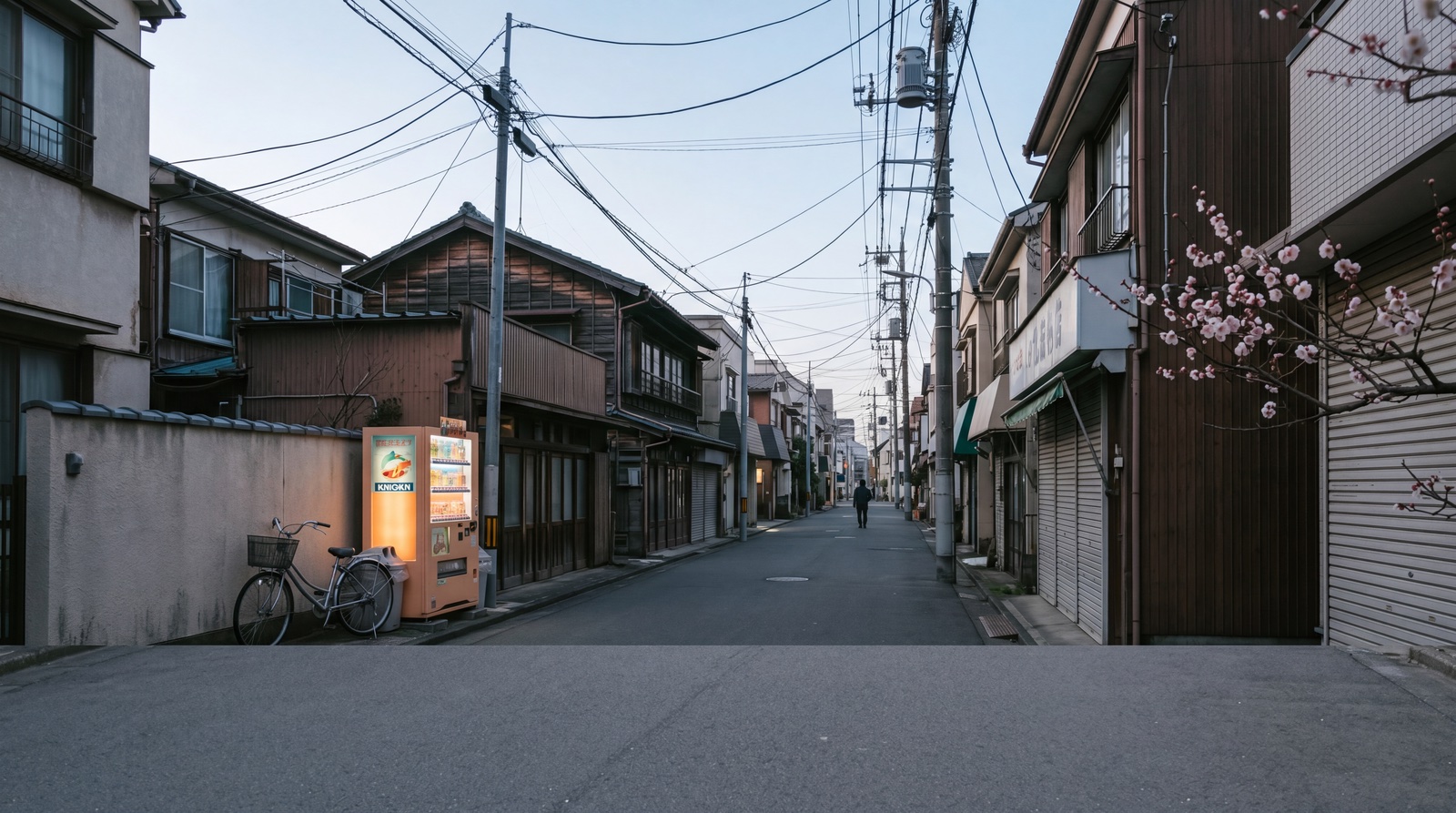
First morning in Tokyo. The family is at the hotel breakfast — bacon, miso soup, a pastry Maya can't quite identify. No one asks "so what are we doing today?" Each of them, on their own device, opens the Today tab of their own shiori.
It becomes the morning ritual for the rest of the trip. Coffee in hand, devices open, everybody looking at the same day from a different angle. The shiori is not a printed pamphlet — it is the family-facing surface of the Trip Brain, refreshed each morning at 06:30 against the day's weather, reservations, and last night's energy reading.
User UI · iPad-kids (Maya) Three cards. One bring-list. Read aloud on tap.
User UI · iPhone (Eli) Day 01 manga panel. Four beats.
The Sterns clear immigration at Haneda at 06:42 JST after fourteen hours of travel. Three weeks earlier, Rachel staged five day-one decisions in the Trip Brain and set each to Auto: early check-in request, baggage routing to the room, a 13:00 soba reservation (small, quiet, English menu, two blocks from the hotel), and four Pasmo cards loaded with ¥3,000 each. She spent forty minutes on it once, at home, with a clear head.
On the Keikyū Limited Express into Shinjuku, those five decisions were already done. Rachel did not pick a restaurant from a jet-lagged phone. David did not Google "how to get a Suica." The Trip Brain confirmed the soba booking at 06:51 — two minutes after wheels-down — and went silent. The Today card on David's phone shows two lines. The family looks out the window.
User UI · iPhone (David's Today view) Single Today card: "Soba at 13:00, two blocks from the hotel." Three handled items below it — suitcases routed · 4 Pasmo cards loaded · early check-in confirmed. Rachel staged all five on March 1st. The Brain executed at 06:51 JST on March 15th. Autonomy = Auto for transit logistics, Confirm for food — David approved the restaurant choice the day before departure.
The Ghibli Museum lottery opens 90 days before each entry slot. The Brain entered the family in October 2025, the day after Rachel mentioned the trip at dinner. They drew the 11:00 slot for March 17. "No photography inside" is logged as a trip-policy input — the Brain holds the museum's rules the same way it holds the hotel's check-out policy. Not a constraint it enforces; a fact it respects.
Maya (9) has been waiting for this since she was four. She does not ask Rachel for her phone. She sees the Catbus from the entrance corridor, goes very still, and her face does the thing that Rachel will remember for ten years.
On the way out, the Brain proposes one line to David: "Light dinner tonight — somewhere quiet. Maya will want to talk tomorrow, not tonight." That suggestion is not a guess. The Learning Layer records — from three prior trips — that Maya needs low stimulation for 2–3 hours after a high-emotion experience. The Now Layer estimated cognitive load as high: 185 minutes inside, weekend crowds, no phone to decompress. And tomorrow's calendar allows a 9:30 start. Three inputs, one dinner suggestion.
Concept · dinner suggestion mechanism The Brain holds the museum's no-photography rule as a policy input — not a surveillance boundary, a trip fact. The dinner suggestion comes from Learning Layer (Maya · post-high-stimulation pattern, 3 trips) × Now Layer (cognitive load estimated high: 185 min, crowd density, post-peak) × Calendar (late start allowed tomorrow). The Brain saw no faces inside the building.
Pokémon Center Mega Tokyo is the largest Pokémon retail experience in Japan. Eli (13) has saved his birthday money and a Bar Mitzvah gift envelope from his uncle for exactly this moment. He spends ¥4,980 — an Eevee plush (¥2,200), a sealed card binder (¥1,980), and a Charizard pin (¥800) — well within the ¥50,000 total souvenir budget Rachel set for the trip. The Brain does not flag anything.
What the Brain does surface, on David's phone only: "Eli ¥4,980 · Souvenir budget ¥45,020 remaining. Maya — today's anchor not yet scheduled." Below it, a suggestion: a cat café three blocks away, 45-minute session, walk-in available, ¥1,200 per person. David taps it. He books two spots — himself and Maya — for 16:30. Eli gets the store. Maya gets the cats. Both halves of the afternoon are covered.
User UI · iPhone (David only) Budget line: Eli ¥4,980 spent, ¥45,020 remaining. Below it, a Care Architecture prompt: Maya's anchor hour is unscheduled — cat café nearby, walk-in available, ¥1,200/person. Routed to David, not Eli, not Rachel. The Brain's job here is not budget policing — it's making sure both kids leave Ikebukuro with their own memory from the afternoon.
Asakusa at sunset. The Brain has built Eli (13) a five-stop walk through the locations where the first chapter of Demon Slayer is canonically set. It is not a tour. There are no time prompts, no audio guides, no "did you know." What the Brain decided was which locations need a sentence of context — and which ones Eli should arrive at himself.
仲見世通り, 浅草六区, and 凌雲閣跡 (the tower Tanjiro would have seen on the skyline) carry just a pin and a name. The Brain trusts a 13-year-old who has read the manga three times to recognize what he's standing in front of. 吉原大門跡 and 浄閑寺 — the old red-light district gate and the "throwing-in temple" — get a single line each: enough to understand what this neighbourhood was, not enough to turn it into a history lecture. Eli walks the full route in seventy minutes. He doesn't say much. He didn't need to.
User UI · iPhone (Eli's view) Five stops on a stylized Asakusa map. 仲見世通り · 浅草六区 · 凌雲閣跡 — name only, no annotation. 吉原大門跡 · 浄閑寺 — one-line historical anchor each (what this place was, why it matters to the neighbourhood Tanjiro walked through). No pacing timer. No narration. The Brain's judgment call: some places explain themselves; some need one sentence of real-world weight before the manga reference lands.
teamLab Borderless is one continuous space — no floors, no map, no you-are-here. Within twenty minutes of entering, Maya is in the Crystal Universe installation with David, and Rachel is somewhere in the Light Vortex with Eli. None of them know where the others are. Eli, being thirteen, is mildly enjoying this.
The Brain monitors two things. First: David's phone is at 23%, and his Learning Layer has a rule — prompt before 20% in a venue with no reliable charger access. A low-battery nudge appears on his phone only. Second: twenty-five minutes after the family split, the Brain surfaces one suggestion to both parents: "Borderless Café is roughly equidistant from your last positions — 4-min walk each. Good stopping point in about 10 min." Rachel reads it and keeps walking. David taps "heading there." That is the only prompt either parent receives for the full two hours.
User UI · iPhone (parent view) Two items: a low-battery nudge (David, 23%, rule set before departure) and a single meeting-point card — Borderless Café, equidistant, 4-min walk from each last-known position. Both parents received the same card. Rachel dismissed it. David accepted. The Brain sent nothing else for the remaining ninety minutes. The kids' view shows only their own location and a single "find Mom or Dad" affordance.
Day 6. David has taken Eli to Pokémon Center Mega Tokyo for the afternoon. Rachel and Maya are wandering Harajuku and Aoyama with no plan — exactly the unstructured pocket the Brain protects in every itinerary. Around 14:45 a single quiet card appears on Rachel's iPhone: "You saved this on Instagram eight months ago. It's five minutes from where you are. A 2D-look café with matcha sweets — currently about a 30-minute wait, but you can make it before 15:30."
Rachel laughs out loud. "Oh — I had completely forgotten about that." They walk over. They wait twenty-eight minutes. Maya squeaks at the parfait. Rachel posts a photo. Eight months ago, at 2 AM in a Brooklyn kitchen, that same Instagram reel had been one of forty-seven items the Brain quietly indexed in CH 02 · 11.
This is what a Context Brain can do that ordinary search cannot. The reel was tagged with a place. The place is now five minutes away. The afternoon is unscheduled. The weather permits. The audience is exactly the two people who would enjoy this. Eight months collapsed into one quiet push. Search couldn't have done it because no one would have searched.
User UI · iPhone (Rachel only) The original Instagram reel rendered inside the card. Distance, current wait time, two clear actions. Surfaced because four conditions matched at once: proximity, free window, weather, audience.
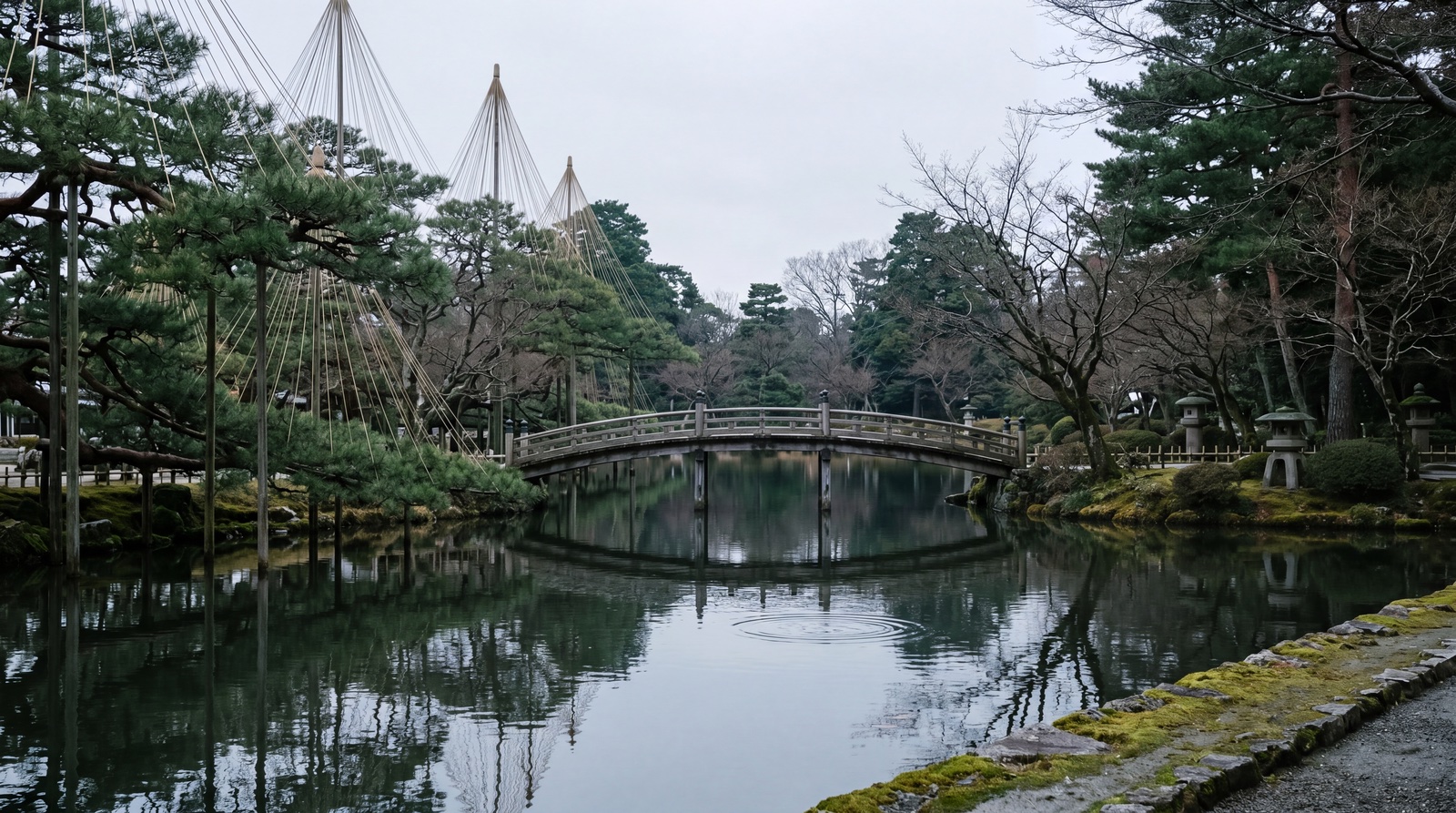
Tokyo to Kanazawa, two and a half hours. As soon as the train leaves Tokyo, each of the four shiori opens its "Next" view. Maya's iPad-kids: a Japan-themed quiz mini-game with cards she can tap as scenery passes the window. Eli's iPhone: a hidden Pokémon Center marker for Kanazawa, surfaced for the first time this trip — with a five-minute walking radius from the station. Rachel's iPad: arrival 11:52, hotel seven-minute walk from the east exit, room key pickup at 12:10, Higashi-Chaya gold-leaf workshop at 14:30.
At the same moment, the carriage display in Car 5 lights up with the public version: arrival time, Kanazawa weather (9°C, cloudy), the lunch trolley at 10:50, Mt. Fuji visible to the right at 09:51 for roughly twenty seconds if the weather holds. The Brain passed a scoped payload to JR East — four seats, party size, today's itinerary. Nothing from the family's Brain or any Disclosure profile crossed the boundary. JR East rendered against the public payload.
Same Token state. Three private shiori in three voices. One public carriage display. One Brain, four renderers, four audiences — each with its own appropriate scope.
User UI · JR carriage display Car 5, row 11A–11D: party-of-4 greeting, Kanazawa arrival 11:52, weather 9°C / cloudy, lunch trolley ETA 10:50. The carriage display gets the public scope. The three shiori get the private scope. The Brain decides which rendering each surface receives.
User UI · iPad-kids (Maya) Quiz cards. Tap as the scenery passes.
User UI · iPhone (Eli) Hidden Pokémon Center marker unlocked.
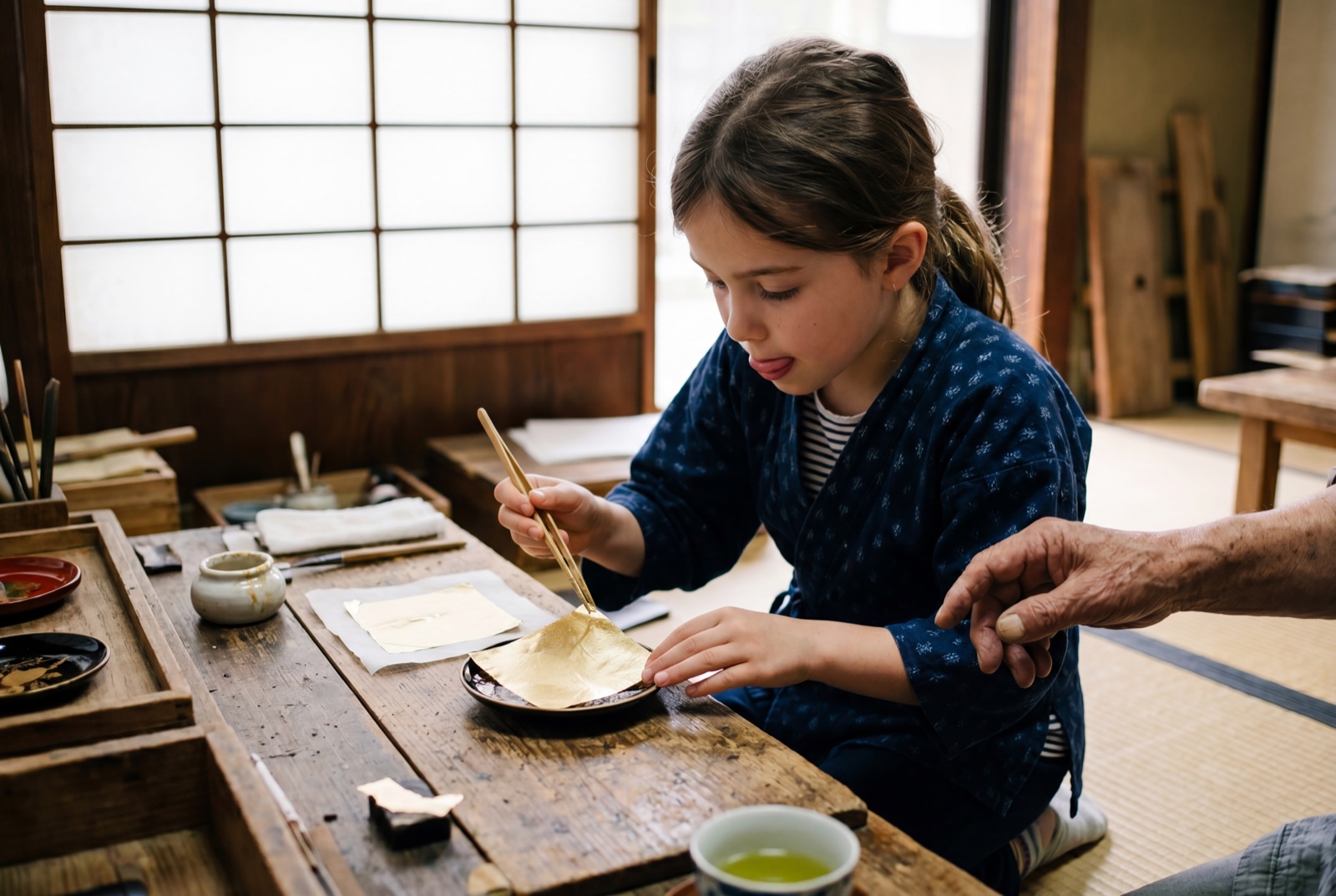
Higashi Chaya district, Kanazawa. A small gold-leaf workshop in a converted teahouse. Each family member receives a lacquered box and a single sheet of edible gold leaf — fragile enough that it tears if you exhale wrong. The instructor demonstrates once, in soft English, and steps back.
Maya (9) does not check the time. She does not ask Rachel anything. For ninety minutes she places the gold leaf, watches it adhere, smooths the edge with the bamboo wand. Her box is finished. It is beautiful. She did it herself. The Trip Brain — logging from David's phone in his pocket — writes into the Trip Learning Layer: "Maya · hands-on craft · 90 min unbroken focus · full engagement." The Learning Layer's prior estimate for Maya's sustained attention on a single task was 60 minutes, based on two earlier trips. That estimate is now 90+.
When the trip ends, this write returns to the Home Brain's Learning Layer. Seven months from now, when Rachel starts planning a trip to Italy, the Brain will surface a pottery workshop as Maya's anchor — not because anyone asked it to, but because the Learning Layer now holds a data point it didn't have before the gold leaf afternoon.
Backstage · Trip Learning Layer write Write record: Maya · hands-on craft · 90 min · full engagement · prior estimate 60 min (updated). This is a positive capability observation — not a limitation flag. Trip Learning writes return to Home Brain's Learning Layer at trip close. Receipts dissolve. The capability data persists.
That night, in the ryokan, the family opens the "Tomorrow" tab on each shiori — the next ritual of the trip. Tomorrow is a Kyoto travel day with the philosopher's path in the afternoon and the rhythm of the move. Lights out around 22:00.
Behind the scenes, the Trip Brain has just written into the Trip Learning Layer: "Maya · hands-on craft · 90 min · full engagement · prior estimate 60 min, updated." A single observation. It triggers a small candidate-slot mutation in the shiori's Kyoto pages.
The next morning at 07:30, Maya opens her iPad-kids and the Today tab has a new sticker: "NEW PAGE." She taps it. "きょうと · おりがみワークショップ · やってみる?" ("Kyoto · origami workshop · would you like to try?") She looks up at Rachel: "これ さっき まで なかったよ?" ("This wasn't here before, was it?") Eli's iPhone has its own version of the same offer — phrased as "Origami workshop · go with your sister?" (Care 2+2 quietly preserved). The shiori is not a printed pamphlet. It learns alongside the family and grows.
User UI · iPad-kids (night before) The 21:00 Tomorrow view, before the new page exists.
User UI · iPad-kids (next morning) The NEW PAGE sticker. One overnight observation, one new offer.
The Stern family has three trip-audiences with different Disclosure settings: NY grandparents (full share), Eli's classmates (curated, no religious dimension), synagogue community (thumbnail + one line, no location precision). The Brain's Disclosure Cascade resolves the output per audience, per day, per scene — never as a one-time settings choice.
// Disclosure Cascade · resolve(audience, profile) → photoset + captions
// Same source data. Three different rendered outputs. Per scene, per day.

resolve(audience: "ny-grandparents", day: "D10-forge")
  → photos:    all 23
  → caption:   "Eli forged a kogatana today. Here is every photo."
  → schedule:  "recipient-morning · daily-digest"
  → tone:      "unfiltered · proud"

resolve(audience: "eli-classmates", day: "D10-forge")
  → photos:    3  // of which Eli pre-approved
  → caption:   "Made a small knife in Japan. Took 4 hours. It's sharper than I am."
  → schedule:  "on-eli-post · only-when-eli-shares"
  → tone:      "casual · self-deprecating"
  → omit:      ["bar-mitzvah", "identity-write-event", "family-emotion"]

resolve(audience: "synagogue-community", day: "D10-forge")
  → photos:    1  // thumbnail only
  → caption:   "Eli's Japan trip — the kogatana he forged in Kameoka."
  → schedule:  "weekly · Sunday"
  → tone:      "warm · communal"
  → fields:    ["thumb", "caption-1-line"]
  → omit:      ["location-precision", "family-photos"]
Backstage view Eli's "casual · self-deprecating" tone for classmates is not a vibe filter — it is an output of his learned voice fed into the cascade. Each audience receives a complete, honest rendering of the day. The three outputs share no layout code — the Disclosure Cascade hands each renderer a Token state, the renderer decides the rest.

Day 8. Toei Kyoto Studio Park. Eli (13) wears a borrowed haori and stands inside a real Edo-period film set, posing for a photo with a life-sized character cutout. He has been waiting for this day since his Bar Mitzvah was announced. He is happy in a way 13-year-olds rarely allow themselves to be visibly happy.
Maya (9) is in the next district over at a small Higashiyama kimono-fitting studio — 2-hour dressing and maiko photoshoot, Rachel with her. This was not the Brain acting alone. Two days before, the Brain surfaced both options within the 2+2 contract constraints: Eli → Toei Studio sword-demo day; Maya → Higashiyama kimono fitting. Rachel reviewed them and tapped OK. The Brain then confirmed both bookings. Each kid gets their own iconic photo, their own story to tell the grandparents — Eli's story is the forge and the haori; Maya's story is the silk obi and the red parasol.
User UI · iPhone (Rachel, 2 days before · Approval Gate) Brain's proposed Care unit: Eli's 4-hour Toei Studio anchor (with David, 13:00–17:00) paired against Maya's 2-hour kimono studio (with Rachel, 13:30–15:30). Reunite at Kyoto Saryo, Sannenzaka, 17:30. Rachel tapped OK to both. The 2+2 stamp confirms the contract was met before any booking was confirmed: equal anchor time, equal weight — different interest, different story.
JMA updated the Kyoto bloom forecast on the morning of Day 9: peak was now March 26 — six days earlier than the forecast when the family booked in January. The Day 13 Maruyama Park plan would land past peak. The Brain identified which stops were affected, moved them to capture peak, held the Day 10 sword forge as an immovable anchor, and surfaced the change as a single before/after card. Rachel tapped Accept. David tapped Accept. Eleven seconds total.
The moment Rachel's tap registered, all three shiori reflowed at once. Maya's iPad-kids flashed a new sub-screen: "あした さくら みえるよ!" ("Tomorrow you can see the cherry blossoms!"). Eli's iPhone redrew the Day 11 manga panel art with a sakura-and-Philosopher's-Path treatment. The Adults shiori showed a fresh timeline with revised transit times, the Day 11 hotel breakfast moved earlier, and a reshuffled spend cap. One approval. Three audiences. Three different stories of the same change.
One tap each from David and Rachel. Eli and Maya don't see the reshuffle UI — they see the new card on their hotel TV at breakfast: "Tomorrow morning, 7 AM. Philosopher's Path. The cherry trees are at peak. Bring sweaters."
User UI · iPhone (David's view) JMA forecast alert at the top. Below it: a before/after schedule comparison — Day 10 sword forge held as anchor (purple), three other days reshuffled (warm). A Care 2+2 confirmation card. Footer shows the four surfaces that will sync on tap: hotel TV, JR pass app, group chat (NY), hotel concierge. One tap. Same Token state. Four renderers.
Day 11. Philosopher's Path, mid-morning, full bloom. The Brain arranged the bento order from a small Higashiyama shop the night before; David picked it up at 11:00. The family spreads a sheet on the grass. There are other Japanese families a few meters away, doing exactly the same thing.
Maya drops a banana and laughs at herself. Eli takes a photo of the cherry petals on his sleeve. Rachel doesn't take her phone out. The Brain sends nothing for the next ninety minutes. A small Now Layer entry — "family laughing for 90 minutes uninterrupted, hanami, full bloom" — is written quietly. There is no notification, no card, no helpful suggestion. Designing an AI well includes designing the moments where it stays out.
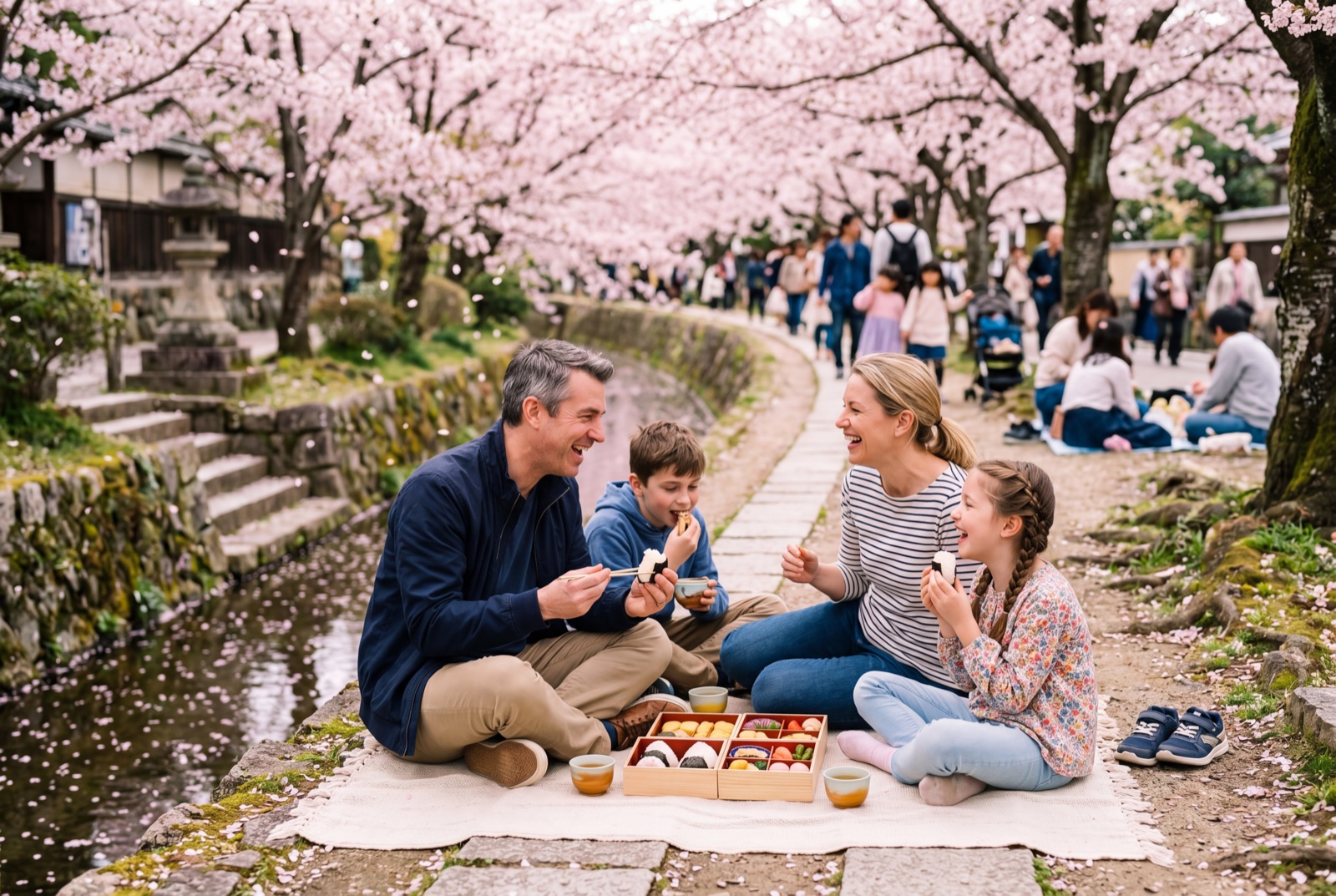
Story · Day 11 The Brain arranged the bento the night before. For the next 90 minutes, it said nothing.
Day 12. The family is in Arashiyama after the bamboo grove. Walking back toward the station, Maya stops at the open door of a small craft workshop where a woman is cutting bamboo into thin lengths for tea-ceremony whisks. Maya's eyes go wide. She turns to Rachel: "Can we stay here a bit?"
Rachel opens her iPad. Maya's iPad-kids has a single large button labeled "I want to do this more" — Maya's pre-arranged way to ask the Brain for time on something the schedule didn't include. Rachel sees the request. Below it, a Brain proposal: "Push the rest of the day 90 minutes back. Kyoto Station meet-up moves from 18:00 to 19:30. Tonight's Pontocho dinner rebooks 19:45 → 21:00 (same restaurant, table held). Day-13 schedule unaffected. Care 2+2 still balanced." Rachel taps Confirm. The Brain rebooks. Maya stays at the workshop for ninety minutes.
A nine-year-old asked the Brain for more time. The Brain solved it inside the constraints, surfaced the trade-off, and let the parent decide. A static guidebook can't do this. A flat reservation system can't do this. A Brain with the family's whole-day state can.
User UI · iPad (Rachel) Maya's child-initiated request on the left. The Brain's proposed 90-minute reflow on the right. The 2+2 balance and Day 13 are both preserved before the Confirm button is even visible.
The AX Pattern library is a vocabulary, not a catalog. The sakura reshuffle scene above looks like a single moment — but mechanically, four patterns compose to make it work. When the next chapter needs the same scene with different inputs, the Brain reuses the patterns. Same vocabulary, different sentence.
AI drafts the new schedule. Each adult approves with one tap. Autonomy = Confirm for trip experiences.
When the order changes, the per-kid balance must not. The composer rejects any reshuffle that breaks 2+2.
Triggered by a Feasibility Token shift (sakura date moved). Anchors are immovable; everything else can flex.
After approval, the new schedule renders to phone, hotel TV, JR app, and group chat — same Token state, four renderers.
Four AX Patterns plugged together produce the scene the family experiences as "the trip noticed." Pull any one pattern out and the scene breaks: no Approval Gate = AI is bossy; no Care Architecture = Eli wins, Maya loses; no Live Recomposition = the family scrolls a static itinerary; no Cascade = Rachel re-tells the kids what changed.
Backstage view In CH 05 the same four patterns will compose differently — Eli's fever (Feasibility shift) instead of sakura (Feasibility shift), Autonomy downgrade instead of reshuffle. Same vocabulary. Different sentence. That is what makes a pattern library a system instead of a Pinterest board.
Kameoka. Twenty-five minutes by JR San-in line, west of Kyoto. A small forge behind a sliding wooden door. The Brain found this forge eight months ago — cross-referencing Eli's Learning Layer (maker interest, historical interest, physical activity preference) against the Bar Mitzvah trip intent Rachel had stored in the fall. It booked an interpreter, Hanako, who specializes in craft vocabulary and pre-briefed Masahiro-sensei on the family context before the day. The master knew Eli was 13, that this was the first time he had held a forging hammer, and that the visit meant something beyond tourism.
Eli is given a 15-centimeter bar of unforged steel. He will turn it into a kogatana — a small kitchen blade, useful, not symbolic. Four hours. The forge is hotter than he expected. The hammer is heavier than he expected. The first strike misses the steel and sparks against the anvil. He flinches. Masahiro-sensei laughs gently, repositions Eli's hands, says one word Hanako renders as "again."
For three hours and forty minutes, that is what Eli does. Strike. Heat. Strike. Heat. He stops asking Hanako to translate. He stops checking his phone. At hour two his shoulder hurts and he wants to stop. He doesn't. At hour three the steel starts to take a shape that did not exist when he walked in. At three-forty, Masahiro-sensei tells Hanako to tell Eli that the next strike will be the last. Eli nods. He brings the hammer down. The blade is finished.
For those four hours, David's and Rachel's phones were quiet. Not because the Brain had nothing to do — the schedule was running, the afternoon restaurant hold was active, the group-chat digest was queued. The Brain was running. The family rule for immersive anchors is no interruptions, and the Brain had that rule. It held everything until the forge door opened.
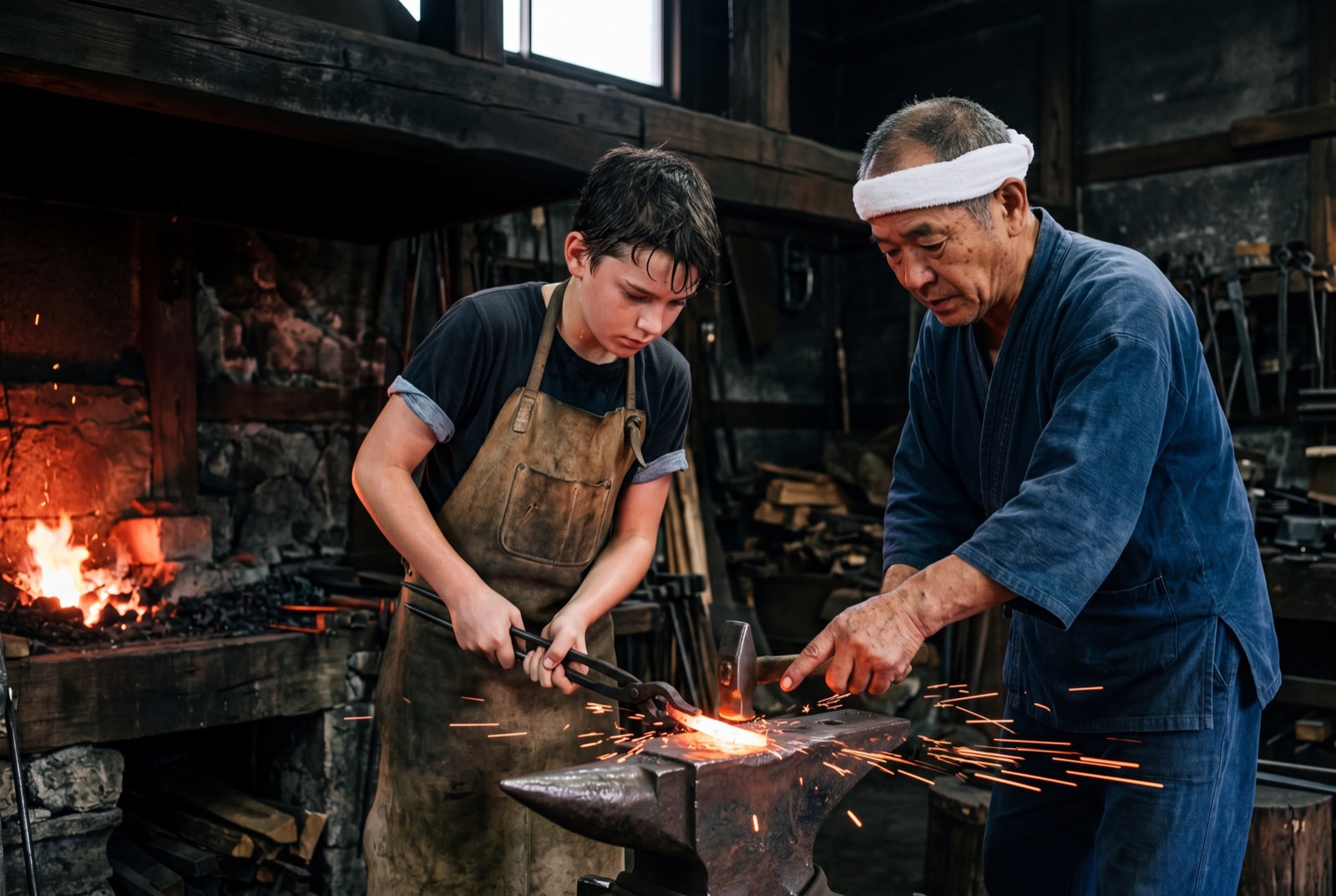
At 16:42 JST, four criteria were met: 4-hour duration, physical product completed, phone not checked for 4 hours, self-reported pride on the return train. The Brain wrote to Eli's Identity Layer — not because Rachel instructed it to, but because the criteria thresholds were crossed.
brain.identity.write({
  member:  "eli",
  field:   "self-concept.maker",
  value:   true,
  source:  "trip-2026-03-japan / day-10 / kameoka-forge",
  evidence: [
    "4-hour-attendance",
    "physical-product-completed",
    "phone-not-checked-during-task",
    "self-reported-pride-on-return-train"
  ],
  contract: {
    on-return:   "merge-into-home-brain.identity",
    on-dissolve: "persist"  // identity writes outlive the Disposable Brain
  }
})
A Bar Mitzvah is the moment a community recognizes a child as old enough to be responsible for their own choices. The synagogue did that in February. Four criteria met. One Identity Layer write. Eli is now a maker in the Brain's permanent record.
Backstage · Identity Layer write Identity writes are rare. They persist past the Disposable Brain's death. This write was triggered autonomously — 4 evidence signals crossed threshold, no Rachel instruction required. It will outlive the trip, the Brain that hosted it, and the schema version it was written in. By next March, the Home Brain will have been treating Eli as a maker for a full year.
The kogatana moment is one event in the Brain. Four downstream surfaces render it — each in its own modality, scoped to its own Disclosure audience. The Brain hands each surface a Token state, never a layout. The renderer decides what to do with it.
A single card in David's Today view. Time, place, one photo, one line. No alert, no badge. He sees it at dinner.
emit({
  surface: "phone-timeline",
  audience: "david",
  alert:   false,
  payload: {
    photo: "forge-final.jpg",
    line:  "Eli finished it."
  }
})
When the family returns to the hotel room, the TV greets them with a slow ambient slideshow of the day. The forge photos play between the bamboo grove and dinner.
emit({
  surface: "hotel-tv-ambient",
  audience: "family-room-only",
  trigger: "door-open + 19:30",
  payload: { slideshow: 14 }
})
NY grandparents have full-share Disclosure. The Brain composes a 3-photo digest with a one-paragraph caption David edited at breakfast. Sent in their morning, NY time.
emit({
  surface:  "imessage-thread",
  audience: "ny-grandparents",
  schedule: "recipient-morning",
  draft:    true  // David approves
})
The synagogue community follows Bar Mitzvah families' first big trips. Disclosure profile gives them: thumbnail + one-line caption. Sent weekly. No identifying location data.
emit({
  surface:   "weekly-digest-email",
  audience:  "synagogue-community",
  schedule:  "weekly · Sunday",
  fields:    ["thumb", "caption"]
})
Backstage view Same Token state. Four projection contracts. The Brain is modality-agnostic — phones, TVs, group chats, weekly emails are all renderers. One event in the Brain; four different outputs, each scoped to its Disclosure audience.
Day 11. Hotel breakfast. Maya is mid-pancake. Rachel opens the Care balance ledger — not because something is wrong, but because seeing the numbers is what 2+2 means. It is not a report card. It is a fact sheet. The Brain shows it as a ledger: Eli's anchor experiences on the left, Maya's on the right, day by day.
Each anchor is a 1.5-to-4-hour experience built around that child's interest. Side-by-side gives one parent confidence the trip is balanced even when, on a single day, it isn't. Maya is not having Eli's trip. Eli is not having Maya's. Both are having theirs.
User UI · iPhone (Rachel · breakfast · Day 11) Two summary cards (Eli 22.0 hr · Maya 21.5 hr · Δ 30 min · resolves D13). Below: the day-by-day ledger highlighting D10 Kameoka with a small id-write chip. Tomorrow's preview at the bottom shows the Brain's proposed parallel anchors. Care Architecture · 2+2 surfaced as a ledger, not a memory.
Day 13. Kyoto, 02:18 JST. Eli's forehead is hot. Rachel reads 39.1°C on the thermometer. The Brain — quietly running on her phone on the bedside — detects the thermometer reading, the rate of acetaminophen administration, and the family's body-position pattern (nobody is sleeping). Within ninety seconds it does three things, none of them through a notification — and it pulls every domain's Autonomy up a notch (Auto → Confirm, Confirm → Suggest). The system becomes less efficient on purpose. Efficiency is not the goal at 02:19. The parents being in charge is the goal.
// Autonomy state at 02:19 JST (after fever detection)

dials.autonomy = {
  transit:      "auto"     // → "confirm"
  food:         "confirm"  // → "suggest"
  experiences:  "confirm"  // → "suggest"
  medical:      "suggest"  // unchanged — already at floor
}

// Three actions taken without waking the parents:
①  hotel-pms.message-front-desk({ request: "english-speaking-doctor", urgency: "morning" })
②  trip-now-layer.flag("day-14-tentative")  // no plan canceled · just held
③  pharmacy-search("24-hour", "radius=600m", "english-friendly")
       → results held silently for 06:00 surfacing

// What the Brain did NOT do:
×  push notifications to the parents at 02:19
×  cancel any booking automatically
×  draft a message to NY grandparents

// Each shiori responds in its own voice:
maya.shiori:    "きょうは おやすみ。ホテルで えいが みよう。"
eli.shiori:     "Sister resting today. Forge moves to tomorrow."
adults.shiori:  "4-domain Autonomy downgrade · re-eval at +12h."
Crisis cascade is the framework's most counterintuitive design choice. The Brain steps up to be more careful, not more autonomous. Twelve hours later the Brain re-evaluates each domain and auto-restores the original ceilings if the conditions hold.
Backstage view At 06:48 Rachel wakes. Below is what her phone shows her — three options ready, no irreversible action taken overnight.
User UI · iPhone (Rachel · 06:48) Eli's 39.1°C reading at the top. Below, the autonomy-state pills make the downgrade visible: "Auto → Confirm" on transit, "Confirm → Suggest" on experiences. Then three options ranked by fit (hotel doctor recommended), each with ETA, cost, and English-speaking flag. Footer: "NY grandparents not notified — you decide what they hear." The Brain caught Eli without grabbing the wheel.
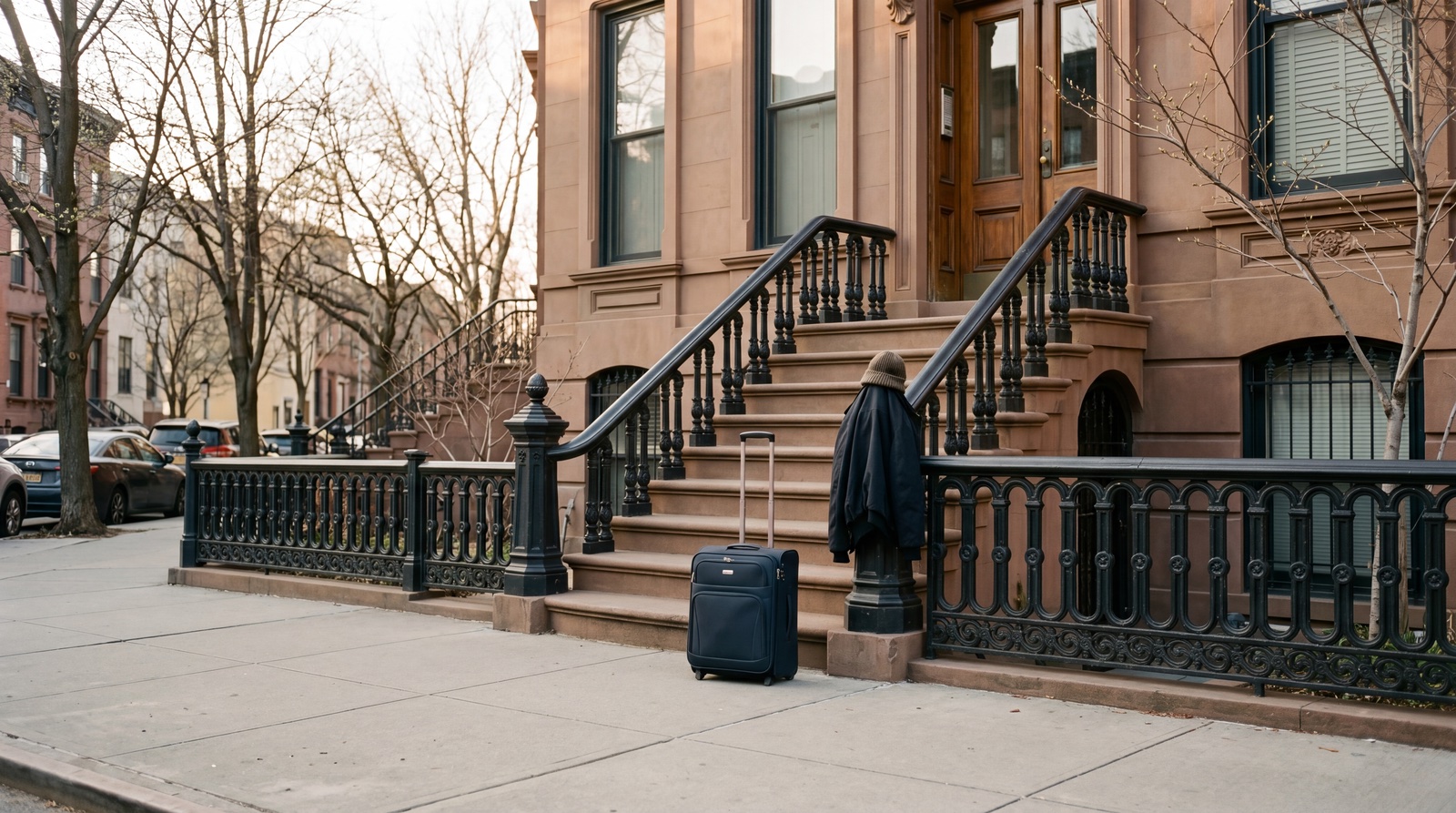
The Sterns land at JFK on March 30 in the late afternoon. They sleep for ten hours. The next morning, the Brain begins the formal Return phase of the Disposable Brain Lifecycle — distilling 14 days of observation into a small, durable set of writes back into the Home Brain. Not photos. Not receipts. Not bookings. Those will dissolve. Seven facts about who the family became.
Photo libraries, receipts, hotel codes, train tickets — all of those stay in the Disposable Brain, queryable for 30 days, then dissolve into the Graduated Archive (P1 Pattern). The Home Brain keeps only what changes how the family gets known.
User UI · iPhone (Home Brain inbox) One Identity write at the top (purple chip · "Eli is a maker") — the Bar Mitzvah moment crystallized as software. Six Learning writes below (green chips) — pacing, recognition, food agency, ryokan rating, Care 2+2 hold. Bottom: a dissolving panel showing what won't survive (1,142 photos · 47 PMS codes · 23 receipts · 8 cascades · real-time Now Layer).
September 2026. Friday-night dinner. Rachel mentions, half-aside, that maybe Italy could be next year — Eli's interest in craft has stayed; Maya has been begging for the Cinque Terre cat colonies she found on YouTube. The Brain is listening at the standard household ambient-attention level. It says nothing during dinner.
Three minutes after they finish eating, a single card appears in David's phone inbox. "A candidate Disposable Brain for Italy 2027 is ready to inspect — pre-loaded with what we learned from Japan. No bookings, no commitment. 8-day or 12-day skeleton. Want to look?" David shows Rachel. They look. The skeleton already knows that Eli wants a Tuscan blacksmith day, that Maya wants Cinque Terre, that the family hates rushing, that one stay should be non-software. Nobody asked it to know.
User UI · iPhone (Home Brain inbox) A candidate Disposable Brain for Italy 2027 sits in the inbox three minutes after dinner. The "what the candidate already knows" panel shows where each fact came from: Eli's blacksmith day from the Identity write, Maya's hands-on slot from the Learning write, family pacing from the ryokan rating. Two skeleton options (8-day and 12-day · Brain prefers 12). Memory compounds across trips. The family Brain knows the family better every time it goes anywhere.
Brooklyn. A Saturday morning weeks after the trip. Eli makes himself a bagel. He uses the kogatana to slice it. The blade is sharp; the bagel falls apart cleanly. Nobody photographs it. Nobody opens an app to log it. Maya is drawing cats at the table. David is reading. Rachel is making coffee.
The Brain did its job. The trip is over. The blade is in the kitchen now.
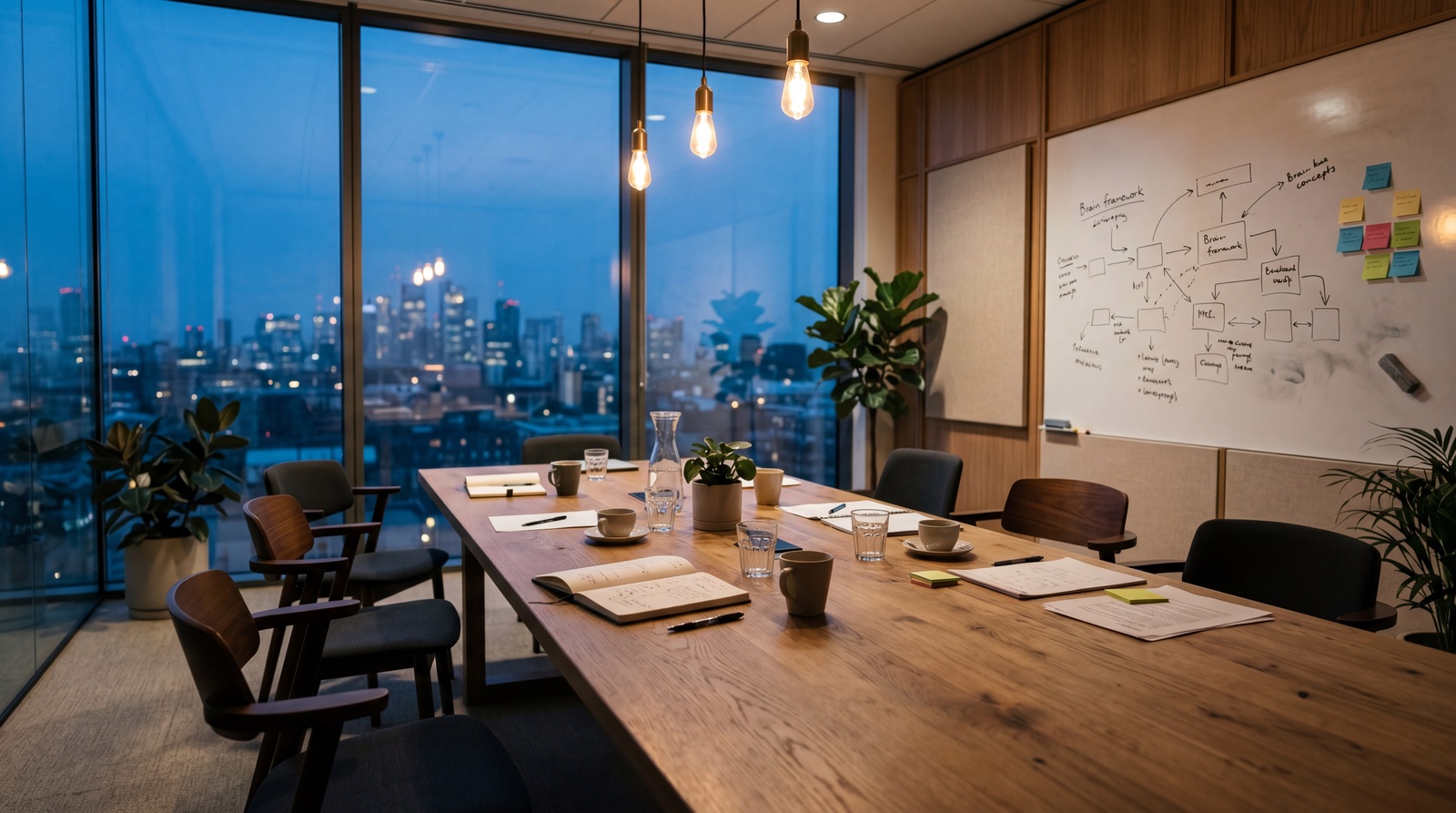
A trip is a coordination problem with stakes, time pressure, multiple stakeholders, shifting feasibility, and a clear lifecycle. So is a corporate offsite. The Stern family ran on a Disposable Brain forked from a Home Brain. A product team can run on a Disposable Brain forked from an Org Brain — the canonical P4 (Atlas) construct. Same 8 Tokens. Same 2 Dials. Same lifecycle.
Same lifecycle: Birth (kickoff, fork from Org Brain) → Learn (4 days of session-by-session observation) → Return (distilled deltas: roadmap moves, hiring intents, team-learning patterns) → Dissolve (session transcripts dissolve to the Living Meeting Brain; only the deltas persist).
Backstage view The framework is not a family-trip framework. It is a coordination-with-stakes framework. Family trips and product offsites are two instances. Healthcare visits, college tours, mergers, festivals, election campaigns are others. Same eight Tokens. Different sentences.
The Stern family's 2026 trip ran on phones, hotel TVs, train carriages, and group chat. By 2030, ambient computing in hospitality will replace much of that — voice, projection on shoji-style screens, haptic floor cues, ambient lighting that responds to schedule + cognitive load. The Brain framework is modality-agnostic. Same Token state. New renderers.
Concept · 2030 ambient room The shoji on the right wall projects tomorrow's first plan in soft light. A faint warm line along the tatami edge cues the path to the genkan. There is no screen. There is no remote.
When a guest asks "what's tomorrow," the Brain answers in their household language at the ambient volume the room learned during check-in.
Tomorrow's first plan, weather glyph, departure window — drawn in light onto rice paper. Disappears when the guest looks at it for more than four seconds.
A barely-perceptible warm line guides the path to the genkan when departure approaches. Not an alert. A hint that knows your shoes are by the door.
The Brain framework is not built for screens. It is built for state. When the screen disappears in 2030, the framework will still know what the guest's cognitive load is, what the room's social exposure is, what the family's Disclosure profile is. The renderer changes. The grammar holds.
Every number below is indicative — designed-but-not-measured. The Stern family did this trip; the Brain that ran it is a design proposal. The "without-Brain" baseline is the family's own estimate of how their previous trip (a 10-day European trip in 2024 with the same kids) compared. We are not pretending these numbers were captured. We are showing what the framework aims to move, and how we'd measure it once shipped.
Pre-trip explanations to AI tools per day. Eliminated by the Tokens-as-Contract handoff once.
Total decisions reaching a parent's notification surface per day. Silent Resolution + Approval Gate together.
Days on which sibling-anchor balance held. Estimated from the prior trip baseline (Rachel's recall) vs the framework's contract.
Time from "the plan needs to change" to "the plan changed and the family knows." Live Recomposition + Multi-surface Cascade.
Number of audiences receiving an appropriately-curated rendering of one event (NY grandparents · classmates · synagogue).
Persistent Identity-Layer writes from the trip's distilled return. Rare by design. The Bar Mitzvah moment, in software.
Senior portfolios show output. They also show reasoning. Here are six judgment calls that shaped the case study — three the project kept after debate, three it cut after testing them.
A fictional trip would have given more narrative control. The real Bar Mitzvah trip carries authority a fiction cannot. "This actually happened" is structurally more credible than "this could happen." Privacy is preserved by changing names, not events.
An earlier draft used a Kyoto rainstorm + Live Recomposition as the climax. It demonstrated the framework well, but mechanically — not emotionally. The forge demonstrates the framework and earns the Bar Mitzvah meaning. One scene doing two jobs.
A reviewer worried the religious framing might narrow the audience. The opposite is true: a Bar Mitzvah is a globally-legible coming-of-age frame that gives the case study an emotional anchor. The framework's universality is what generalizes — not the trip's anonymity.
An early draft had a v1-style 4-card grid with avatar portraits. It worked, but it diluted the emotional landing right after the Hero. Replaced with a single full-bleed family photograph + text overlay — one stop, one image, four people.
A first draft of the forge scene was written in Eli's voice. It was emotionally strong but structurally wrong — the case study's reader is the designer, not the family. Third-person preserves the framework as the subject and Eli as the moment.
P1 v2 ran five dark sections back-to-back at the end of CH 01 and lost narrative rhythm. P2 v2 caps CH 01 Backstage at three. The remaining Backstage sections are distributed inside the chapters they support (Disclosure Cascade in CH 03, AX Composition + Multi-modal in CH 04).
A framework that claims to handle every case is selling something. Here are five places where this case study runs out of answer — and where the next iteration will need to do real work.
The cross-vendor Brain layer described in CH 01 · 08 is a proposal. Matter took ~5 years from announcement to ship. We don't know if the four major platforms would adopt before consumer pressure forces them to.
"Eli is a maker" is a defensible write. But what about smaller writes? "Maya tolerates spicy food now"? "David is more anxious in airports than he admits"? The threshold for a permanent identity-write needs an explicit policy, not a vibe.
"Casual · self-deprecating" for Eli's classmates is what the Brain learned from his own messages. But what if the trip changed his voice and the Brain's read is six months stale? Disclosure-tone needs an explicit "this doesn't sound like me" override path.
Maya is nine. The Brain has more memory of her than she has of her own life. What rights does she gain at 13? at 18? The framework needs a per-member maturation contract that gradually shifts authorship from parent to child.
A lost phone, a partial sync, a vendor outage on day 7. The framework assumes a continuous Brain. The real-world degraded path — paper handoffs, family-only mode, partial state recovery — is sketched but not fully designed.
A case study should leave the reader with something portable — patterns that travel beyond the specific story. Here are the three from this trip.
Most agentic-AI projects design state but not lifespan. When does this Brain instance die? What gets returned? What dissolves? The Disposable Brain Lifecycle (Birth → Learn → Return → Dissolve) is portable to any temporary context: a project, a hospital stay, a school year. Start your next agent design by drawing the lifecycle, not the dashboard.
Care Architecture · 2+2 made fairness explicit — visible to parents, defensible to kids, queryable by grandparents. The pattern generalizes: any system serving multiple stakeholders with competing claims (siblings, co-founders, customers, oncall engineers) benefits from showing the balance instead of asking a human to remember it. If your AI mediates between people, surface the balance ledger.
Three audiences saw three different versions of the kogatana day. None lied. None required the family to maintain three feeds. resolve(audience, profile) is a function whose output is the rendered story. If your product has privacy choices, replace the settings page with a resolve function.

A Brain that watches a child become adult — and writes it down.
A Bar Mitzvah is the moment a community recognizes a child as old enough to be responsible for their own choices. Kameoka did the same thing. The Brain wrote it down.