Context Grammar — Floor 5

AX Patterns

23 named patterns for how AI delivers, escalates, and adapts. When the Rule Engine fires, these are the shapes the response takes.

AX Patterns

Techniques, not recipes

A recipe says what to cook. A technique says how to handle the knife. Context Grammar's Rules are the recipes — they decide what to do. AX Patterns are the kitchen techniques — they decide how to execute it, regardless of which dish you're making.

A pattern is device-independent, Token-triggered, and reusable. D2 Progressive Trust works the same way whether you're on a phone, a fridge display, or a car screen — the trigger is Brain L2 success count, not the surface.
Definition

Pattern vs. not a pattern

Not every design decision is a pattern. A pattern must pass three questions before earning a name in the catalog.

1

Token condition?

Does a specific Token value trigger it? If the trigger is vague ("when it feels right"), it's a heuristic, not a pattern.

2

Reusable across contexts?

Can it work in grocery shopping, travel planning, and enterprise approvals? If it only fits one scenario, it's a feature, not a pattern.

3

Device-independent?

Does the interaction logic hold regardless of form factor? If it breaks outside of phones, it's a component, not a pattern.

Pattern

D4 Omakase Mode

Full delegation to AI — activated when Autonomy = Auto, Disclosure = Full, and Brain L2 trust is high.

  • Trigger: three specific Token conditions must all be true
  • Works in grocery, scheduling, travel booking, enterprise
  • Same logic on phone, fridge, CarPlay, or enterprise dashboard
VS

Not a pattern

"Smart suggestions"

Shows a suggestion when the AI feels confident. No defined trigger, no consistent form, no reuse contract.

  • No specified Token condition — just "confident"
  • Implementation differs per product team per quarter
  • Cannot be tested against a consistent success criterion

Categories

Four categories, 23 patterns

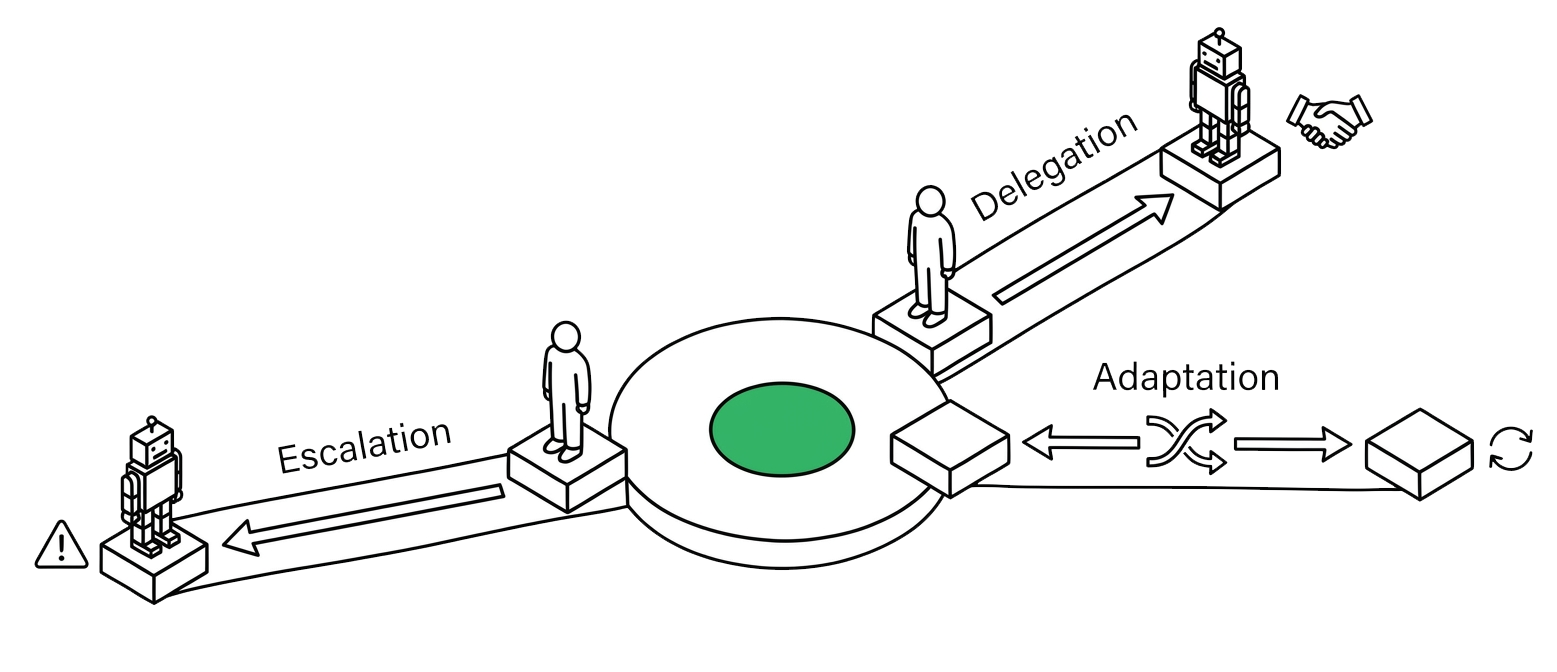
Every pattern belongs to one of three directions — Delegation, Escalation, Adaptation — plus an Enterprise extension. Each direction is mutually exclusive at the conceptual level.

Three Response Directions — AI to Human (Delegation, Escalation, Adaptation), Human to AI, and AI to AI information flows
D · Delegation

Transferring authority to AI

6 patterns

Designing how humans gradually hand decisions and execution over to AI. Trust is the prerequisite — these patterns both measure it and act on it.

Human → AI
E · Escalation

Returning decisions to humans

5 patterns

Designing how AI recognizes its own limits and hands control back. Applies regardless of Autonomy Dial level — AI uncertainty always outranks delegation.

AI → Human
A · Adaptation

UI transforms with context

8 patterns

Designing how the interface restructures itself when Token values change. The content may stay constant while the form, density, and visibility shift.

Context ↔ UI
X · Enterprise

High-stakes organizational patterns

4 patterns

Patterns specific to multi-person, compliance-heavy, or audit-required contexts. Built on the same three directions but hardened for organizational trust requirements.

Team + AI
Live · runs in your browser

See all 23 patterns fire in real time.

Set the 8 context tokens and watch which patterns trigger, which overrides activate, and how Autonomy × Disclosure constrain each other. Every pattern row below has a “Try it” link that opens the simulator with that pattern primed.

Open Simulator →

Pattern Catalog

All 23 patterns

Each pattern: an ID, a canonical name, its one-line essence, and a Yamashiro family example showing it in real life.

D Delegation 6 patterns
D1

Approval Gate

A checkpoint where the user approves, edits, or rejects an AI proposal before it executes.

Trigger: Autonomy = Confirm + Priority Weight = HIGH. Example: The fridge proposes a grocery order — Hana taps Approve, Edit, or Skip before anything is sent.

D2

Progressive Trust

AI earns the right to act with less friction as successful outcomes accumulate over time.

Trigger: Brain L2 success count crosses threshold. Example: Weeks 1–3 Hana approves every grocery sub. By Week 8 the system moves to Notify — she sees the swap after, not before.

D3

Proactive Nudge

AI surfaces a non-urgent suggestion precisely when Cognitive Load is low enough to act on it.

Trigger: Cognitive Load = LOW + Priority Weight = MEDIUM + Feasibility = OK. Example: Saturday morning, nobody's rushing — the app surfaces "Kai's soccer cleats need replacing, end of season sale now."

D4

Omakase Mode

Full delegation to AI in a domain where trust, disclosure, and Brain confidence are all at maximum.

Trigger: Autonomy = Auto + Disclosure = FULL + Brain L2 trust ≥ HIGH. Example: Hana says nothing — the regular grocery order runs itself, exactly as she would have placed it.

D5

Substitution Modes

Four levels of substitution freedom — Exact, Flexible, Exploring, Surprise — per item and per risk level.

Trigger: Item out of stock + Brain L1 holds substitution settings. Example: Koji's peanut butter is set to Exact (allergy risk). The yogurt brand is Flexible. A new snack is Surprise.

D6

Dynamic Friction

High-cost or high-risk actions keep a confirmation step even when overall trust is mature — a ceiling that Progressive Trust cannot exceed.

Trigger: Feasibility × Risk ≥ threshold. Example: The fridge reorders yogurt automatically. But a ¥15,000 appliance always asks first — trust and risk are independent axes.

E Escalation 5 patterns
E1

Confidence Signal

AI displays its uncertainty in graduated levels — not hiding doubt, but making it legible.

Trigger: AI confidence ≤ 80% + Social Exposure ≥ MEDIUM. Example: The travel app shows "71% match — alternatives available" for the hotel recommendation, not a confident single choice.

E2

Limitation Disclosure

AI honestly names what it cannot do and redirects to the appropriate resource.

Trigger: Request outside AI capability + Priority Weight = HIGH. Example: Mia reports feeling unwell mid-trip. The app says "I can find nearby clinics, but I cannot make medical decisions" and shows a map.

E3

Rollback

AI reverses a completed action and offers alternatives when external conditions change after execution.

Trigger: Already executed + Feasibility changed post-execution. Example: The booked 14:00 flight is cancelled by the airline. The app strikes it through, shows a 16:30 alternative at no extra cost.

E4

Ambiguity Escalation

AI surfaces gray-zone decisions with a warning and explicitly defers the final call to the human.

Trigger: AI confidence = 40–79%. Example: The planner isn't sure if Kai would enjoy a particular museum. It flags the doubt, shows two options, and says "your call."

E5

Trust Breach Recovery

After an AI misjudgment, the Autonomy Dial is demoted and trust is rebuilt from a lower stage.

Trigger: User rejects or undoes an AI decision. Example: Hana rejects a substitution she explicitly blocked. The system demotes from Notify → Suggest and confirms every swap until trust is re-earned.

A Adaptation 8 patterns
A1

Form Factor Transform

The same content restructures itself when the active device changes — a different vessel, not a different message.

Trigger: Form Factor changes (Phone ↔ TV ↔ Watch). Example: The family trip itinerary is a scrollable list on Hana's phone; cast to the TV it becomes a full-bleed timeline with photos.

A2

Cognitive Scaling

Information density and number of choices contract when Cognitive Load is high, expand when it drops.

Trigger: Cognitive Load = HIGH. Example: Running late at the airport, Hana sees three pre-selected options. At home on a quiet evening, she sees the full 12-item list.

A3

Social-Aware Filtering

Displayed content shifts based on who is present — prices, wish lists, and personal notes hide as exposure increases.

Trigger: Social Exposure ≥ MEDIUM + Disclosure Dial ≠ FULL. Example: Alone, Hana sees prices and budget stats. At a dinner party, the TV shows the recipe — no costs visible.

A4

Disclosure Cascade

Information visibility moves through four levels — FULL → SUMMARY → EXISTENCE → HIDDEN — per domain and per person.

Trigger: Disclosure Dial setting × Social Exposure change. Example: Koji's medical history: Full for Hana, Summary for the family doctor's app, Existence-only for the school nurse's form.

A5

Disposable Surface

A UI instance is born for a specific purpose and dissolves when that purpose is complete — tied to the Disposable Brain lifecycle.

Trigger: Intent = time-bound goal + Disposable Brain created. Example: The Kyoto trip UI appears the morning they leave, learns during the trip, and disappears when they arrive home.

A6

Care Architecture

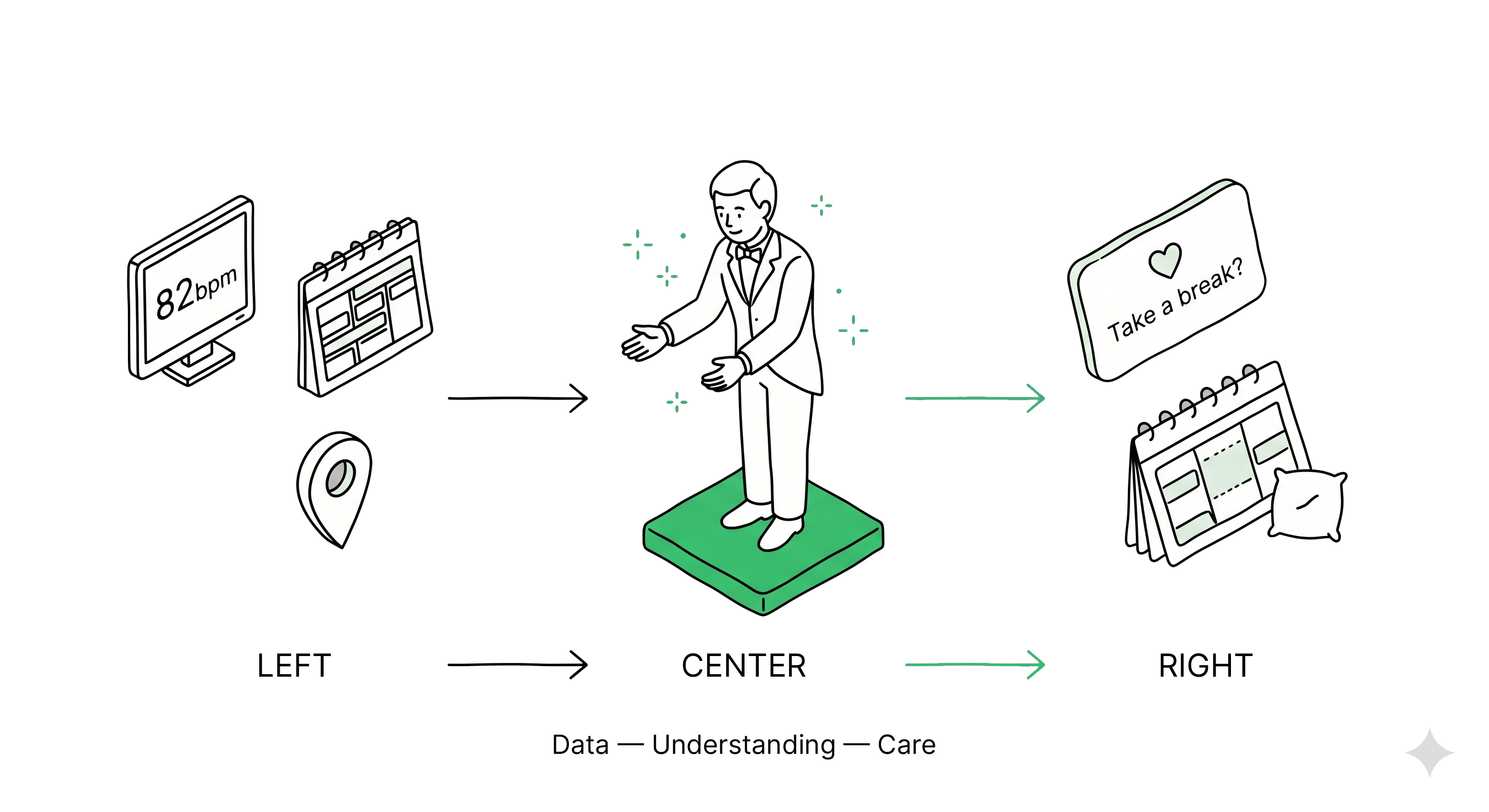
AI tracks emotional and relational context to surface care opportunities buried in daily life.

Trigger: Brain L2 relationship data + emotional context change. Example: The app surfaces "Hana's mother's birthday is next week — last year you sent flowers" before she thinks to check.

Care Architecture — AI surfacing care opportunities from Brain L2 relationship data
A7

Live Recomposition

An existing plan is instantly rebuilt when external conditions change — weather, cancellations, or inventory — without the user seeing the seam.

Trigger: External Feasibility change + existing plan present. Example: The outdoor market is rained out. The itinerary silently swaps it for an indoor museum at the same time slot.

A8

Temporal Handoff

When a Disposable Brain ends, its distilled learnings return to the persistent Home Brain — the temporary context dissolves, the knowledge survives.

Trigger: Disposable Brain lifecycle ends + Brain L2 integration window opens. Example: After the Kyoto trip, "Kai loves ramen" and "Mia fades at 3pm" are written into the Home Brain. The Trip Brain is gone.

X Enterprise 4 patterns
X1

Reasoning Trace

AI decision rationale is available in a collapsible format — auto-expands for high-risk decisions, silent otherwise.

Trigger: Priority Weight = HIGH or user requests expansion. Example: The AI recommends Vendor A. Priya sees the answer; tapping "Why?" reveals the three CRM threads and two calendar entries that drove it.

X2

Inline Edit

An AI proposal can be edited in place and immediately re-executed — the "edit" path within Approval Gate.

Trigger: "Edit" selected at an Approval Gate. Example: The AI drafts a sales email. Priya changes one sentence inline; the system re-runs the draft and returns a revised version in seconds.

X3

Autonomy Dial UI

Explicit user control over the four-stage Autonomy level — Suggest, Confirm, Notify, Auto — paired with the Disclosure Dial.

Trigger: User explicitly adjusts in settings. Example: Priya sets the brief-writing agent to Confirm for client-facing content, Notify for internal drafts, Auto for first-pass research summaries.

X4

Source Attribution

AI answers include the specific data sources that produced them — CRM, email, calendar — meeting audit and compliance requirements.

Trigger: Compliance rule active or user requests source evidence. Example: "Q3 revenue up 12%" is shown with chips: CRM · Email · Calendar · Sheets — traceable in one tap.

Composition

Patterns compose

A single pattern rarely runs alone. Real agentic behavior is the result of several patterns firing in sequence or in parallel. Here is one example: Silent Resolution — how the Yamashiro family's grocery order handles a blocked item without interrupting anyone's morning.

1

D4 · Omakase Mode

The order runs on its own

It's a Tuesday morning. Autonomy = Auto, Disclosure = Full, Brain L2 trust is high for the grocery domain. The weekly order runs without prompting anyone.

2

D6 · Dynamic Friction

A ¥4,800 item hits the friction ceiling

One item — a specific supplement — is out of stock, and the cheapest alternative costs ¥4,800, above Hana's per-item risk threshold. Dynamic Friction blocks auto-execution for this item only.

3

E5 · Trust Breach Recovery

Hana rejects the alternative

The app surfaces the blocked item with a low-friction notification. Hana rejects the substitute — she wanted the original brand only. E5 records the negative signal in Brain and demotes the Autonomy Dial one stage for this item category.

4

A2 · Cognitive Scaling

The recovery notice arrives at the right moment

The system waits until Cognitive Load drops — after school drop-off, calendar clear. Then it presents a two-option card: keep waiting for the original brand, or skip this week. Not twelve choices. Two.

Result

Silent Resolution

The order completes. One item is held. The family's morning is not interrupted. Trust is recorded accurately — the system knows this category needs more confirmation. No single pattern produced this outcome. Four patterns, in sequence, did.

Why It Matters

Why a library, not a list

A list is a collection. A library is a shared contract. When every team names and describes patterns consistently, design decisions become verifiable, transferable, and composable.

01

Reusability

A pattern defined once works in grocery, travel, healthcare, and enterprise — any surface where the same Token conditions arise. Teams stop reinventing the same interaction from scratch.

02

Consistency

When D1 Approval Gate looks and behaves the same across six product areas, users build one mental model, not six. Consistency is not a visual style — it's a behavioral contract.

03

Verifiable

A pattern with a named trigger condition can be tested. "Did D6 Dynamic Friction fire when Feasibility × Risk exceeded the threshold?" is a question with a yes/no answer. Vague heuristics cannot be audited.

04

Growing catalog

23 patterns today. As new project contexts are designed — P5, P6, enterprise verticals — new patterns are extracted, named, and added. The library grows without breaking the patterns already in use.

Q&A

Questions

Q Can a product team invent its own patterns without using this library?

Yes — but without a shared name and a specified trigger condition, the pattern cannot be reused, referenced in a spec, or tested by QA. The library's value is the contract, not the catalog. Teams can extend it; they just need to follow the three-question filter.

Q What is the difference between a Direction and a Pattern?

A Direction (Delegation, Escalation, Adaptation) is a coarse category — it describes the relationship between human and AI. A Pattern is a specific, named, trigger-defined interaction inside that category. All D patterns involve trust transfer; D4 Omakase Mode is the specific form that transfer takes when trust is maximal and disclosure is full.

Q Why are there only three Directions? Why not four or five?

At the conceptual level, AI behavior in a delegated system can only go in three directions: hand authority over (Delegation), return authority back (Escalation), or reshape the presentation without changing authority (Adaptation). A fourth direction would either duplicate one of these or describe a different system entirely. Enterprise patterns are not a fourth Direction — they are an overlay of higher-stakes constraints on the same three directions.

Q Does every Token need a dedicated pattern?

No. Tokens are inputs. Patterns are behavioral outputs. Multiple patterns can read the same Token — both D4 and D6 read Autonomy Dial, for example. And some patterns read several Tokens simultaneously (D3 reads Cognitive Load, Priority Weight, and Feasibility together). The relationship is many-to-many.

Q Are the 23 patterns exhaustive?

No — and they are not meant to be. This is the catalog as of Projects 1–5. New patterns are extracted when a design scenario cannot be described by combining existing ones. The rule: if two teams invent the same unnamed pattern independently, it earns a name and a slot in the library.

Next

Patterns define what the AI does. Specs define how to build it correctly — token resolution, priority logic, and integration contracts.