Explicit Intent
The user states what they want by voice, tap, or type. Zero inference needed.
Example
"Call Mom." / "Set a timer for 20 minutes."
AI just executes.
AI just executes.
Context Grammar — Floor 1
Before AI reads the room, it must read what the user wants. Sometimes it's spoken. Often it isn't. Intent is the signal that starts every interaction — and the one today's AI almost always misses.
Intent is Floor 1 of Context Grammar. It's what the user wants in the moment — not a permanent goal, not a demographic. Two kinds: one spoken, one inferred. Get Intent wrong and every floor above it fails.
A · The Metaphor
One restaurant waits for you to ask. The other knows before you do. The difference is not magic — it's memory combined with situational awareness.
B · The Foundation
Most people think Intent means "what the user said." That's half right. Intent comes in two kinds — and in real life, the unspoken one is far more common.
The user declares what they want — by voice, tap, or type. AI executes. No inference needed.
Nothing is said. But the intersection of situation (Token) × memory (Brain) lets AI infer what's probably wanted.
C · How It Emerges
Implicit Intent does not appear by chance. It emerges from a specific intersection: current situation signals (Tokens) read against stored memory (Brain), mediated by Coordinator. Remove any one of the three and the inference collapses.
D · A Real Scenario
Sota (11) winces while trying to put on his soccer shoes one morning. He says nothing. And yet, the home's AI already knows his Intent at 92% confidence. Here's how it gets there.
(Sota frowns at the door, struggling to get his soccer shoes on)
— Tuesday 7:42 · Yamashiro House · Zero words spoken
E · Architecture
"Intent without memory is just a guess." But that memory is not one big database. In Context Grammar, a home runs multiple Brains in parallel — each with a distinct role. Implicit Intent only emerges when Coordinator reads them together.
One per family member. 3-layer structure — Identity Layer (Sota is 11, soccer club), Learning Layer (shoe size changes every 3–4 months), Now Layer (unusual gait this morning). Determines the subject of Implicit Intent.
Purchase history, unresolved household tasks, budget priorities, past failure patterns ("the shoes weren't replaced in time last season"). Provides the family-level context invisible to any single person's brain.
Family calendar, school schedules, work travel, match dates. Determines the urgency of an Implicit Intent. No Saturday match means the shoes can wait. A match in 5 days makes it "buy now."
Not a Brain itself — a cross-Brain reasoning layer. Reads Tokens alongside Person, Household, and Calendar simultaneously, resolves conflicts, and reduces everything to a single Intent proposition. Disclosure Dial and Autonomy Dial settings are read here too.
F · Four Channels
Explicit / Implicit is the right entry point. But when implementing, breaking Implicit into three sub-types keeps design decisions sharp. Floor 1 covers four channels total.
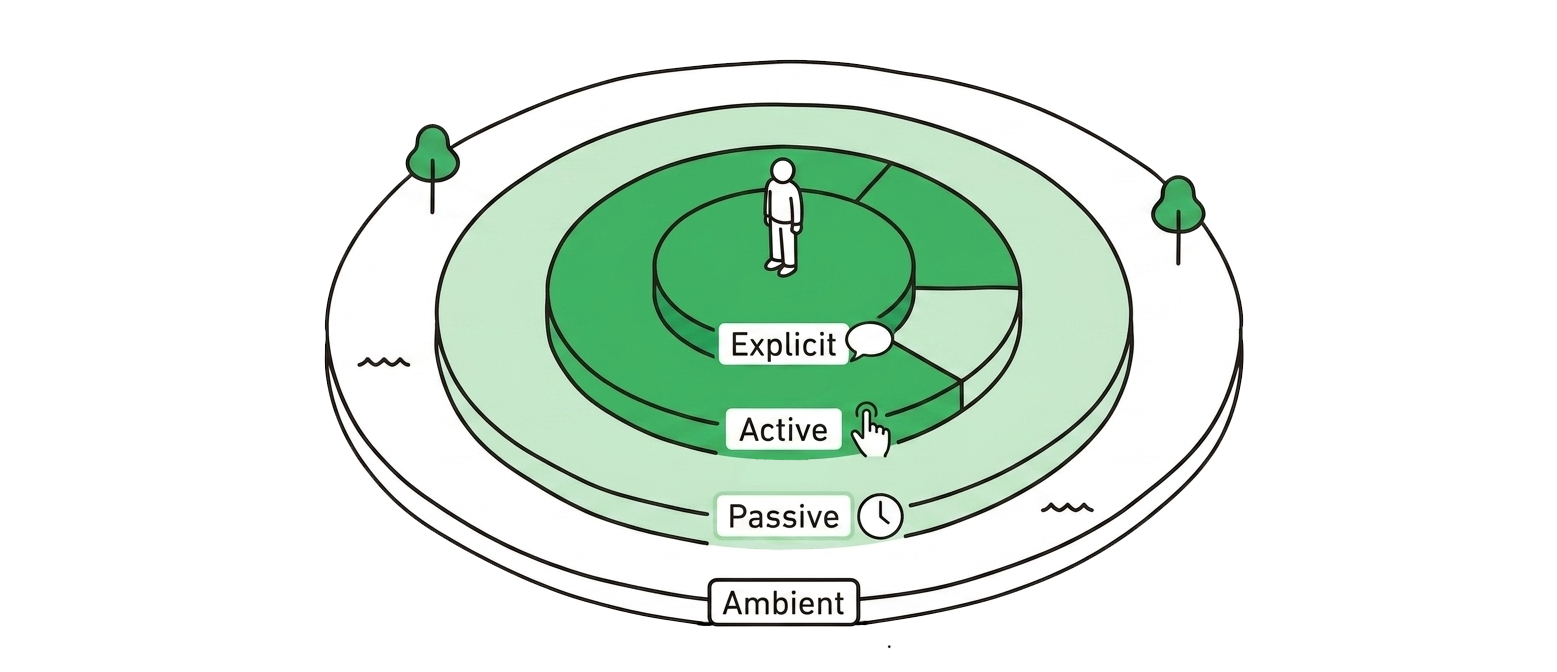
The user states what they want by voice, tap, or type. Zero inference needed.
The user says nothing, but their current action reveals what they want.
The user has a pattern. This moment matches it — so AI knows what usually follows.
A continuous background signal. No specific request — just a state the environment should respect.
Types 2–4 are all sub-types of Implicit Intent. Today's AI handles only Type 1. The other three are the "moments you wish your phone would handle but it never does." Context Grammar makes all four structurally addressable.
G · Intent vs JTBD
Designers with a product background often conflate Intent with JTBD. Both are necessary — but they operate at completely different time horizons.
A durable goal the user "hires" a product to accomplish. Defined once, valid for months or years.
A momentary signal of what the user wants right now. Updated every minute, every tap, every room change.
JTBD tells you what product to build. Intent tells you what the product should do in the next 200 milliseconds. You need both. One without the other gives you either a well-researched product that is constantly annoying, or a responsive AI that is solving the wrong problem.
H · The Formula
Implicit Intent is produced by a specific function. Coordinator executes it. The output is always a proposition paired with a confidence score — never a bare assertion.
Output is always a proposition + confidence pair. Confidence becomes an input to Autonomy Dial stage selection.
I · How It Connects
A common question: "Isn't Intent just one of the Tokens?" No. Intent and Tokens are separate layers. Intent is what is wanted. Tokens are the situational facts that shape how that want gets fulfilled.
Intent → 8 Tokens → Execution flow
J · Common questions
Q1. Is Intent the same as a "Goal"?
No. A Goal (Jobs-to-be-Done) is a long-term target: "lose weight this year." Intent is a moment-level signal: "what do I want in the next minute?" Goals are annual; Intent is per-minute. Goals go in roadmaps; Intent runs at runtime. Both matter — they're just different things.
Q2. Isn't Implicit Intent creepy — being guessed at?
That's exactly why Disclosure Dial and Autonomy Dial exist. Users can set "this far is fine to infer, beyond that ask me" — per domain, per person, per Brain. Sota's shoe situation crosses three Brains (Person × Household × Calendar) because permission exists. Aoi's health data stays inside her Person Brain only. Inference happens only where permission is granted.
Q3. What happens when Implicit Intent is wrong?
Design for being wrong — keep the cost low. Confidence drives Autonomy Dial stage. At 92%, it's still a one-tap confirm, not a silent auto-buy. At 50%, no notification — just a note in the Person Brain's Learning Layer. Low-cost failures by design. Silent wrong purchases are never acceptable.
Q4. How is this different from ChatGPT / Siri / Samsung Family Hub?
ChatGPT and Siri respond to Explicit Intent only — they wait for you to type or speak. Apple Intelligence and Samsung Family Hub have some Implicit capability (household profiles, habit learning, up to 6 member profiles, Voice ID, AI Vision) — but without a structured Intent model. Context Grammar proposes structuring Implicit Intent as Token × multiple Brain intersections, with Coordinator mediating — making "the experienced server's water refill" reproducible by design.
Q5. Where is Intent stored?
Intent itself is not stored. It's a moment-level signal, not persistent memory. Sota's "needs soccer shoes" Intent belongs to this morning — tomorrow's morning has its own Intent.
However, patterns learned from Intent are stored in the appropriate Brain's Learning Layer:
· "Sota's shoe size changes every 3–4 months" → Person Brain (Sota)
· "The Yamashiro family misses the window 5 days before a match" → Household Brain
· "Tuesday mornings have HIGH Cognitive Load 10 min before school" → Calendar Brain
Intent flows through; patterns persist — and they persist in different Brains.
Q6. Why not just merge all Brains into one?
Because merging collapses privacy and ownership boundaries. Aoi's menstrual cycle belongs inside her Person Brain — it should never flow to the Household Brain or Calendar Brain. Household finances belong in the Household Brain — not the children's Person Brains. Separate Brains mean Disclosure Dial can control "which Brain shows what to which Brain" one relationship at a time. One giant merged Brain can't draw those lines.
Intent tells AI what the user wants. The 8 Context Tokens tell AI what is true about the moment that wanting is happening in. Together they turn a one-word request into a full sentence.